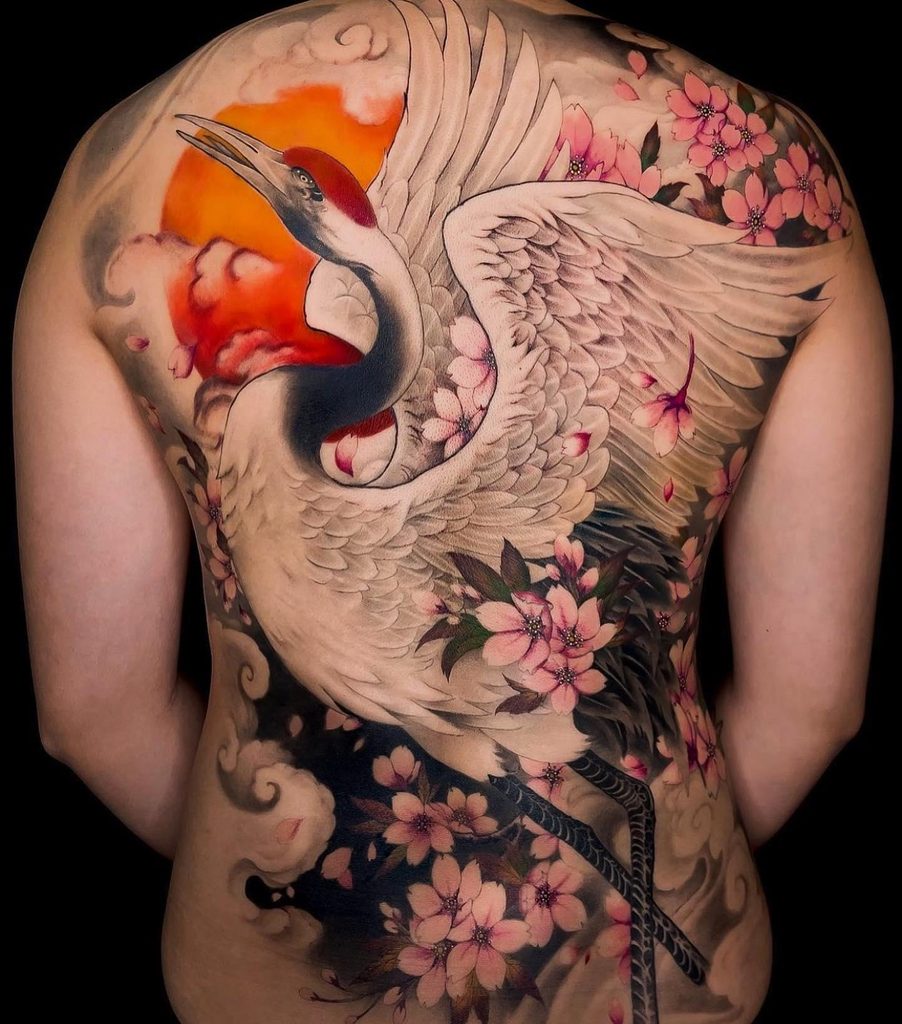
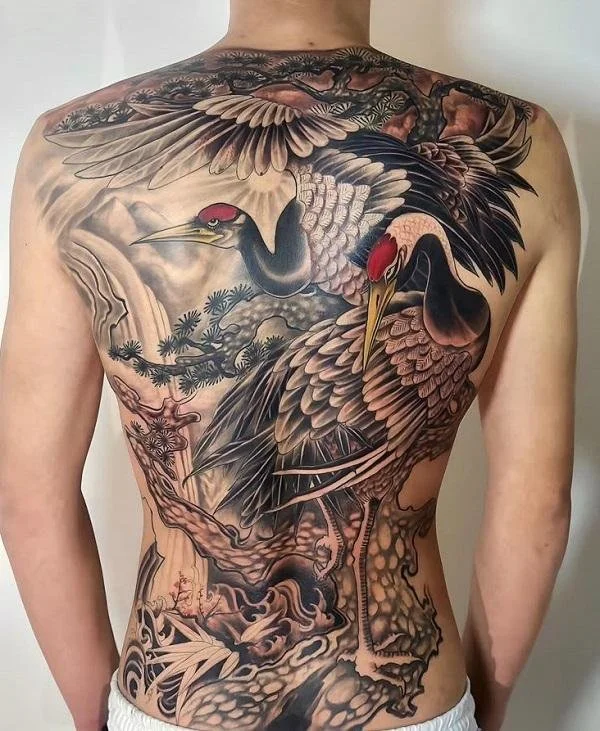
A white crane spreads its wings above the clouds. Its black feathers cut through the sky, while a small patch of red crowns its head. The image is elegant, almost peaceful. Yet behind it lies one of the most enduring symbols in Japanese culture.
The Japanese Crane Tattoo represents longevity, loyalty, good fortune, peace and enduring relationships. Known as tsuru (鶴) in Japanese, the crane appears in traditional paintings, wedding decorations, folklore, textiles and origami.
Unlike the tiger, which communicates strength through physical power, or the koi, which represents perseverance through struggle, the crane carries a quieter message.
It represents a life worth living, a bond worth protecting and the hope that good things will last.
But why did this bird become so meaningful in Japanese culture? And how do its colors, poses and surrounding elements change the story of a tattoo?
What Does a Japanese Crane Tattoo Mean?
A Japanese Crane Tattoo most commonly represents five interconnected ideas:
• Longevity: Wishes for a long, healthy and fulfilling life.
• Loyalty: Devotion, commitment and lasting relationships.
• Good fortune: Blessings, happiness and auspicious beginnings.
• Peace: Harmony, grace and emotional balance.
• Hope: The possibility of renewal and a better future.

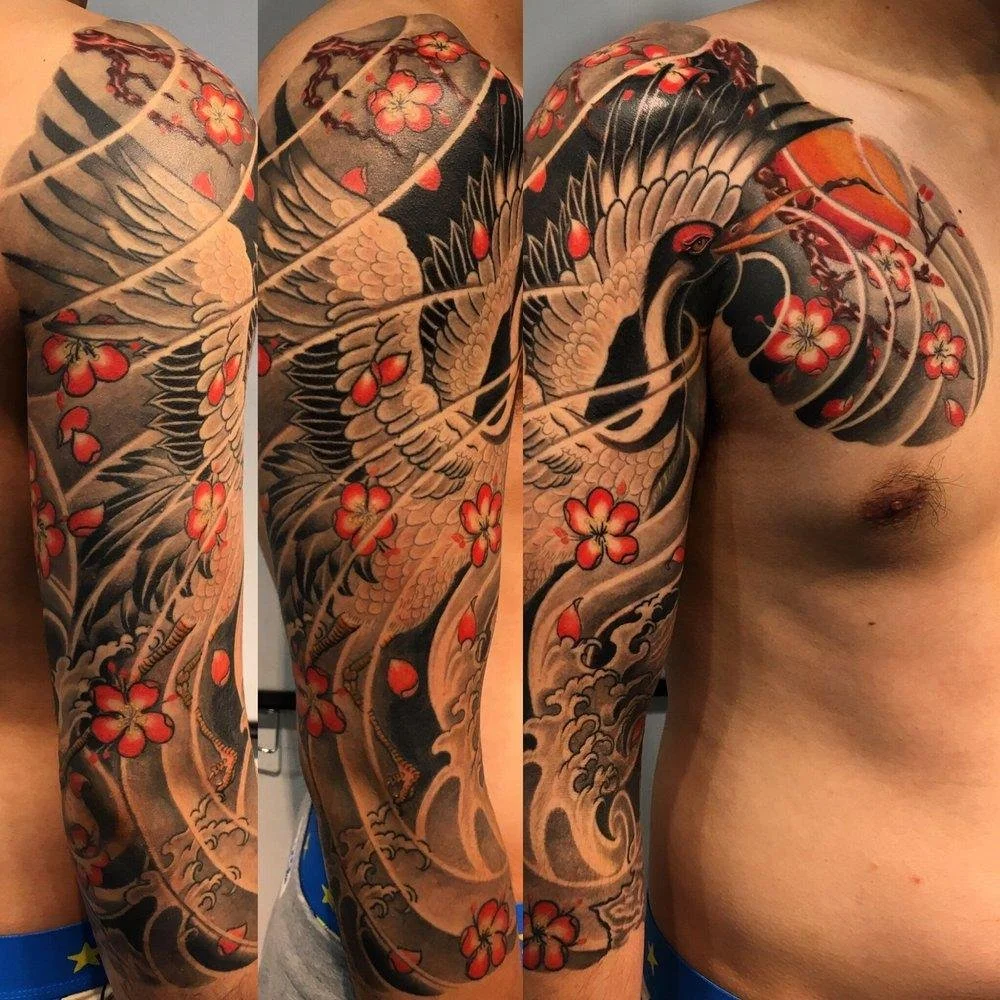
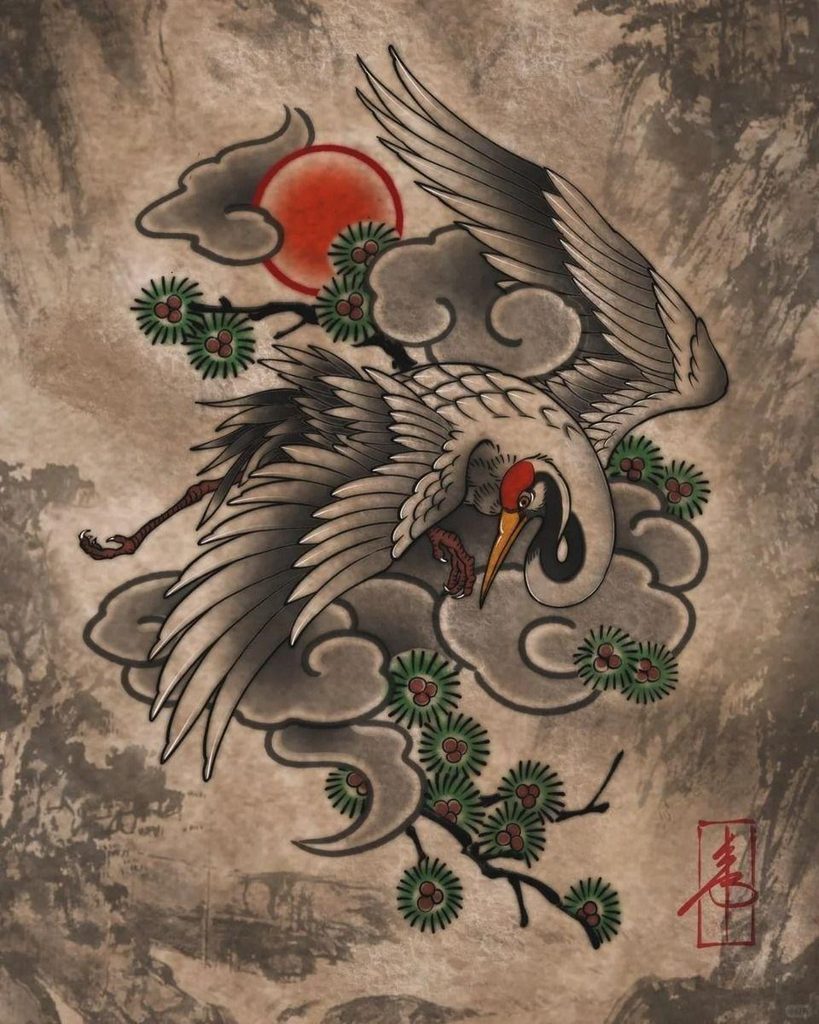
These meanings come from the crane’s longstanding place in Japanese and broader East Asian art and folklore. However, the bird’s symbolism isn’t restricted to one fixed interpretation.
A pair of cranes may represent a marriage. A flying crane can suggest freedom and aspiration. A crane standing beside a pine tree can express wishes for longevity. The crane provides the symbol. Its composition tells the story.
Why Does a Japanese Crane Tattoo Symbolize Longevity?
One of Japan’s best-known traditional sayings is:
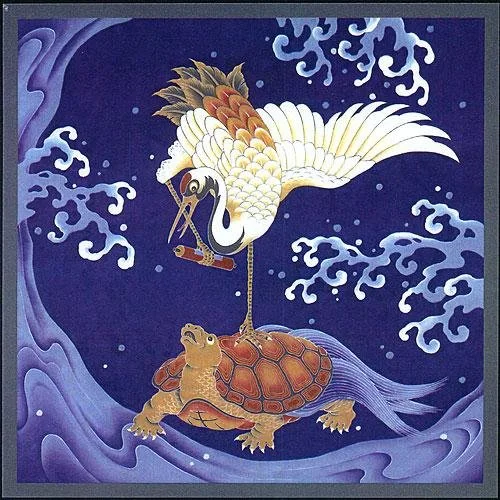
Tsuru wa sennen, kame wa mannen (鶴は千年、亀は万年).
It translates roughly to:
“The crane lives a thousand years; the turtle lives ten thousand years.”
The saying is not a biological claim. It is a traditional expression of longevity and good fortune.
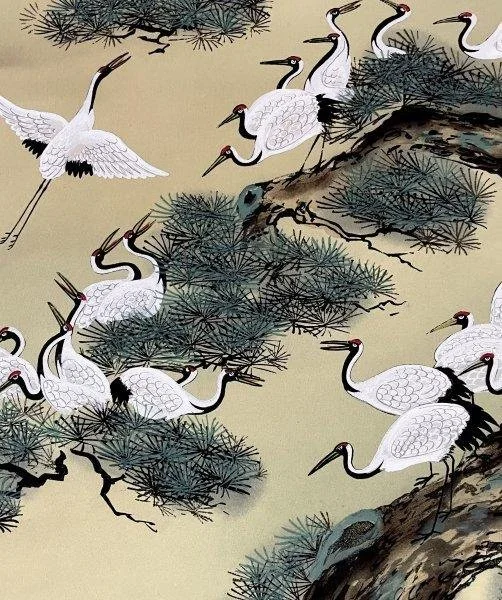
How did cranes become symbols of long life?
In East Asian artistic traditions, cranes became associated with long life, immortality and auspicious blessings. These ideas entered Japanese visual culture through centuries of exchange with China and developed into familiar motifs in Japanese painting, ceramics, textiles and decorative arts.
Cranes were often depicted alongside other longevity symbols, particularly pine trees and turtles. A crane tattoo can therefore represent more than a desire to live for many years. It can express a wish for a long, meaningful life filled with health, happiness and connection.
For some wearers, this symbolism becomes especially personal when the tattoo honors parents, grandparents or someone whose influence they hope will endure.
Why Does a Japanese Crane Tattoo Represent Loyalty?
Cranes are often associated with devotion and enduring partnership
The red-crowned crane, one of the birds most closely associated with Japanese crane imagery, is known for forming long-lasting pair bonds. That natural behavior helped make cranes a fitting symbol of marital harmony and fidelity.
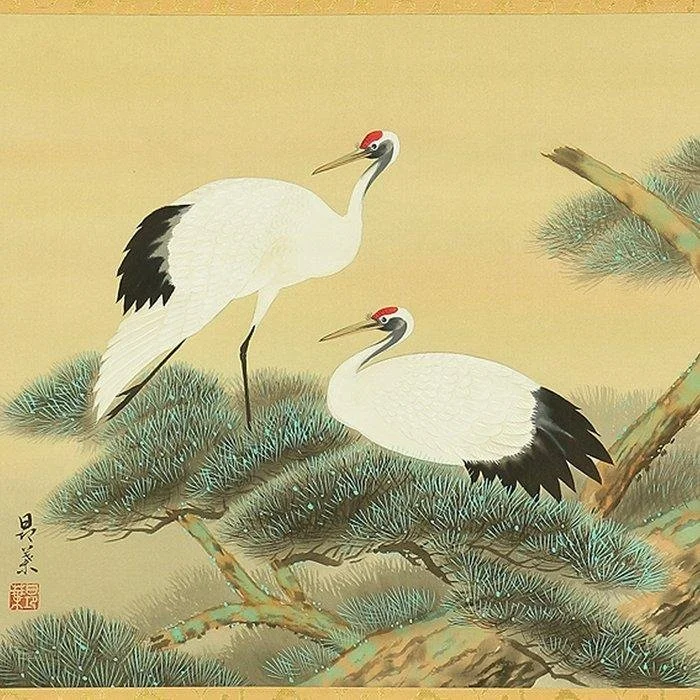
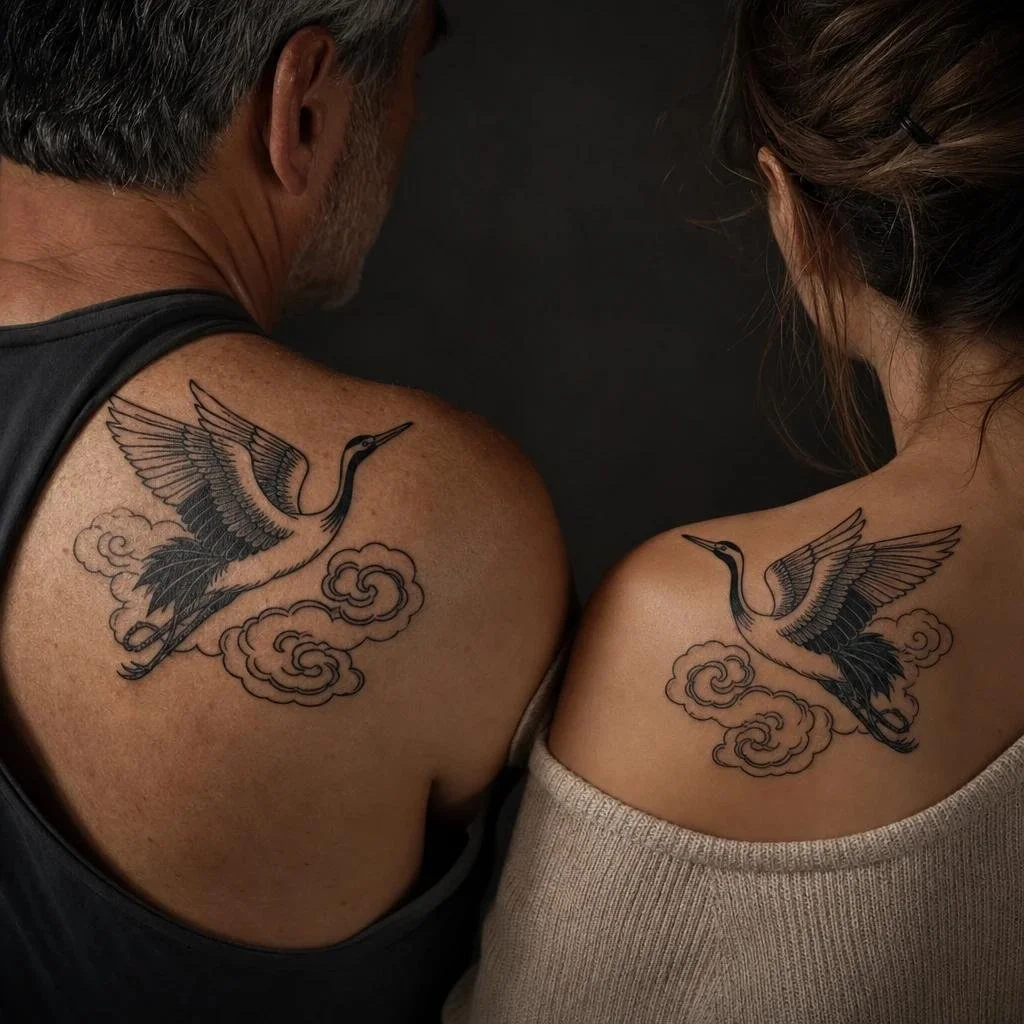
What does a pair of Japanese cranes mean?
Two cranes can represent:
• Marriage and commitment
• Faithfulness between partners
• Lifelong companionship
• Mutual support
• A shared future
This is why crane imagery is particularly meaningful in wedding traditions and celebratory Japanese art.
However, it is worth making one distinction: cranes do not universally remain with the same partner under every circumstance. Their cultural symbolism of lifelong loyalty is an idealized interpretation inspired by their pair-bonding behavior.
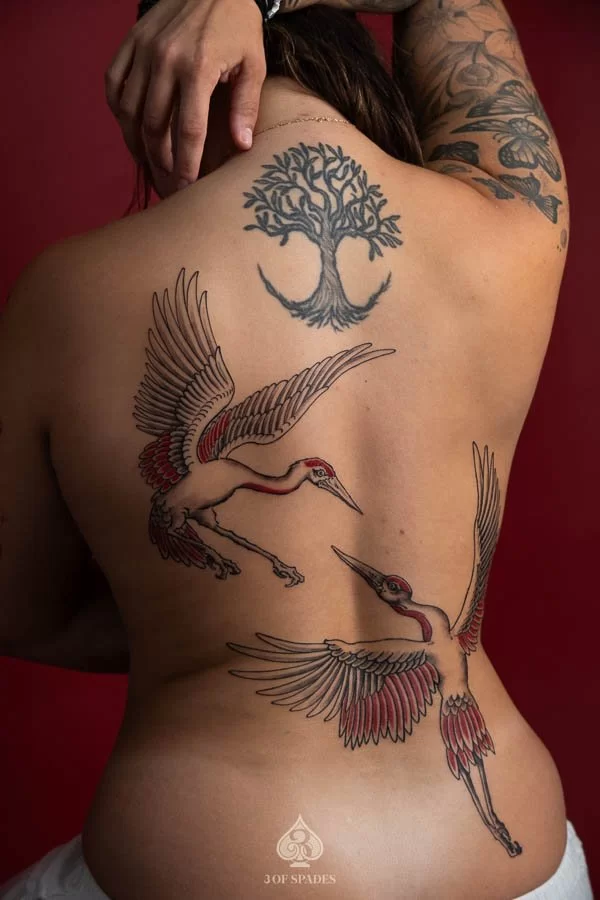
For a tattoo, that symbolism can be especially beautiful. Two cranes do not need to look identical to belong together. One may be flying while the other follows, creating a composition about two individuals moving through life as partners.
Why Is the Japanese Crane Tattoo Associated With Good Fortune?
In Japanese culture, the crane is an auspicious symbol—an image associated with blessings and favorable outcomes.
Its graceful appearance and longstanding association with longevity made it a natural subject for celebrations.
Crane motifs commonly appear in traditional decorative arts connected with weddings, formal occasions and wishes for happiness.
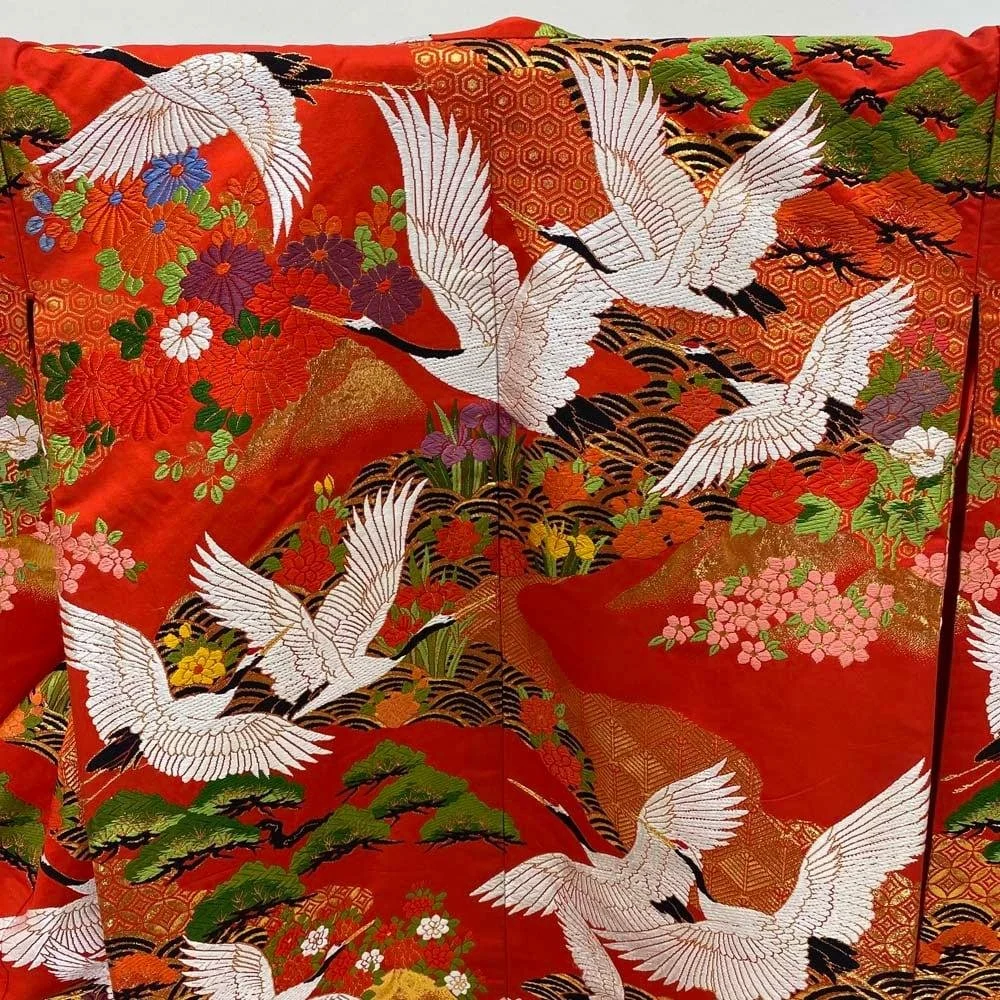
What does a flying crane represent?
A flying crane can suggest:
• Hope for the future
• Positive change
• New beginnings
• Freedom
• Good fortune on a new journey
These are interpretations rather than strict traditional rules about every flying-crane image.
Still, the bird’s movement makes it a powerful choice for someone marking an important transition, such as marriage, recovery, graduation or a new chapter in life.
A crane taking flight can become a reminder that the future is something to move toward with hope.
How Did Japanese Crane Tattoo Symbolism Develop Through Art and Folklore?
The crane’s importance in Japan reaches far beyond tattooing. Its image appears throughout traditional Japanese visual culture, including painted screens, folding fans, kimono textiles, ceramics and woodblock prints.
What role did cranes play in Japanese art?
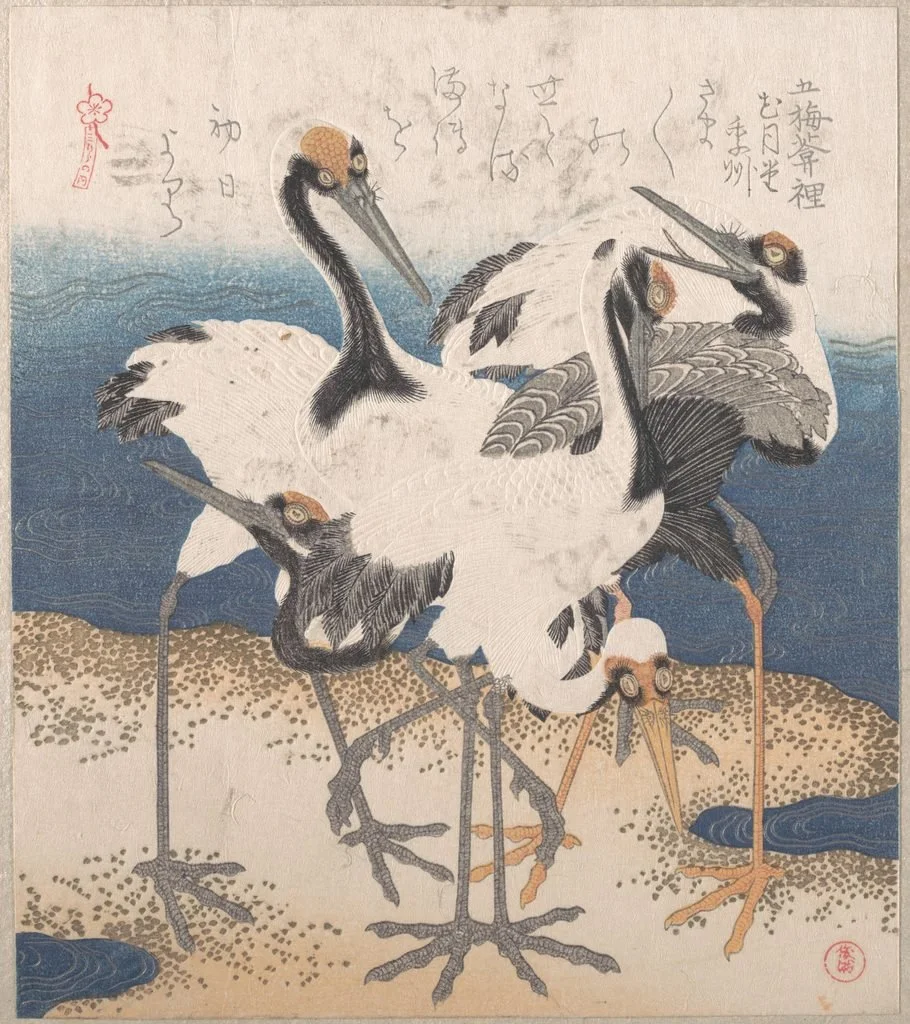
Japanese artists frequently depicted cranes in natural settings: beside water, beneath pine trees, among reeds or flying across open skies. The birds were also incorporated into auspicious compositions intended to communicate good wishes.
Because cranes have such distinctive anatomy—long necks, extended wings and slender legs—they also offered artists opportunities to create graceful, flowing compositions. Those same qualities make them particularly suitable for tattooing today.
What is the significance of the crane in Japanese folklore?
Cranes appear in Japanese folktales, most famously Tsuru no Ongaeshi, often translated as The Crane’s Return of a Favor.
In a familiar version of the story, a man saves a crane. Later, a mysterious woman arrives and weaves beautiful cloth, asking that he never watch her work. When he breaks his promise, he discovers that she is the crane he once rescued. The story explores gratitude, sacrifice, trust and the consequences of breaking a promise.
For someone drawn to this tale, a crane tattoo can carry a meaning beyond good luck: Love and kindness are precious, but trust must also be protected.
Why Does a Japanese Crane Tattoo Represent Peace and Hope?
The crane acquired another powerful layer of meaning in modern Japanese history through the story of Sadako Sasaki.
Sadako was a young girl exposed to the Hiroshima atomic bombing who later developed leukemia. While hospitalized, she folded paper cranes, drawing on the Japanese tradition of folding one thousand cranes in the hope of receiving a wish.
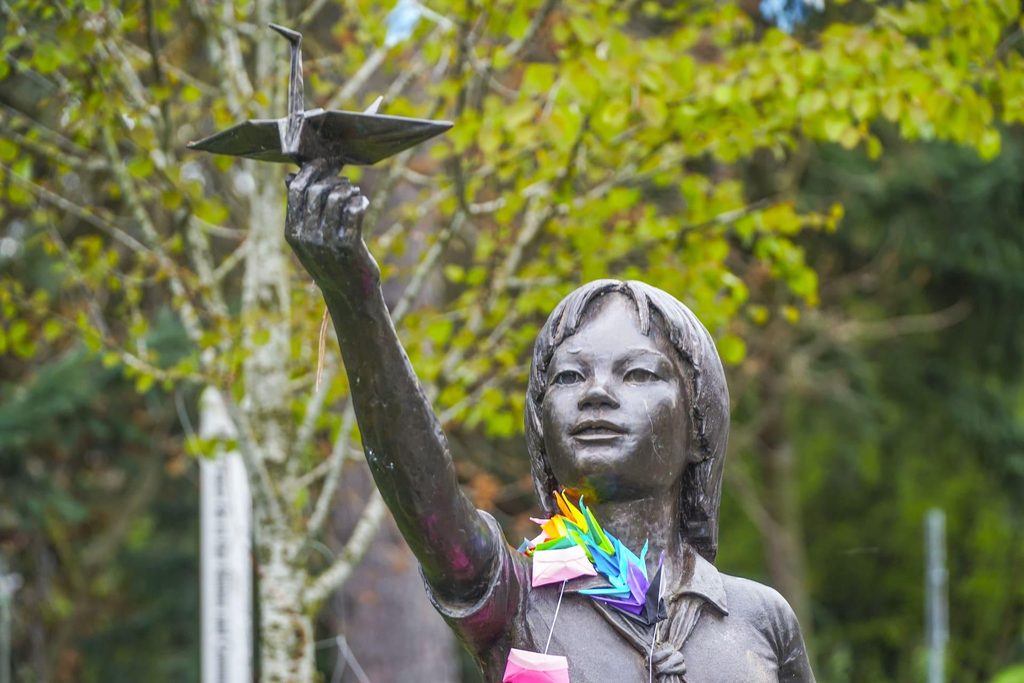
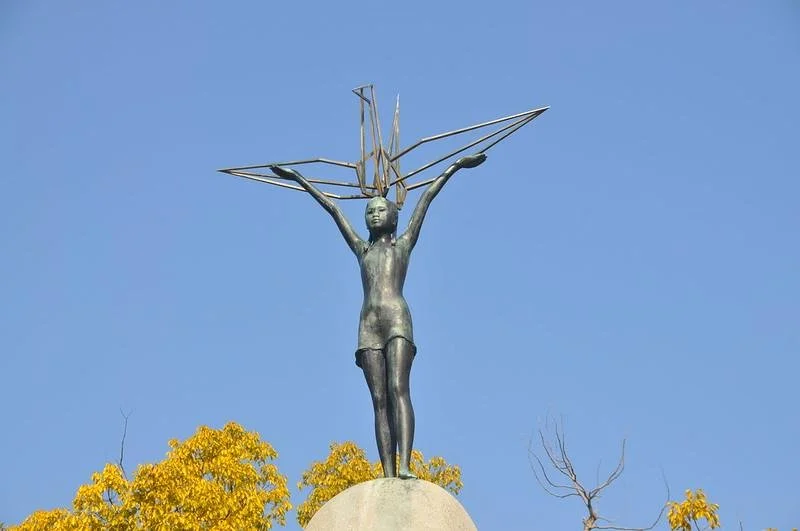
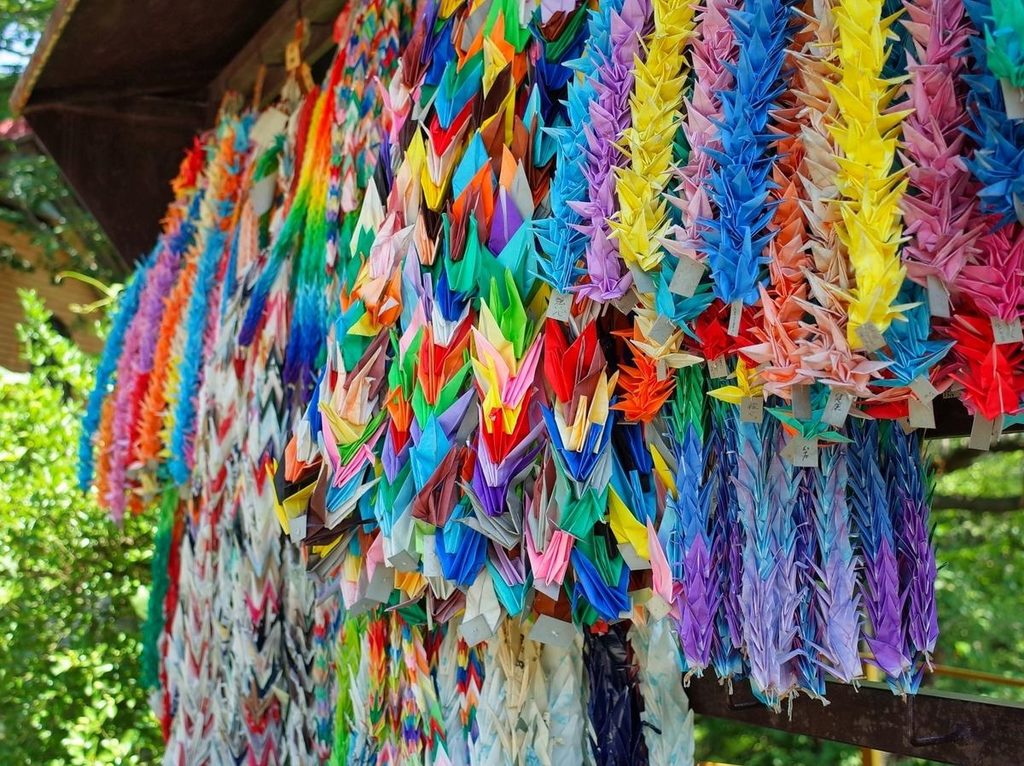
Following her death in 1955, Sadako’s story became closely associated with peace, remembrance and the human consequences of nuclear warfare.
The Children’s Peace Monument in Hiroshima commemorates Sadako and other child victims of the atomic bombing.
What does a Japanese origami crane tattoo mean?
An origami crane can represent:
• Peace and hope • Remembrance • Healing • Wishes for recovery • Compassion • Resilience
A paper crane and a realistic red-crowned crane share cultural connections, but they are not identical symbols.
An origami crane tattoo often emphasizes wishes, remembrance and peace, while a traditional bird composition may emphasize longevity, fidelity and good fortune.
Đọc thêm: Japanese Tattoo History: From Ancient Japan to Modern Irezumi
What Does a Japanese Crane and Pine Tree Tattoo Mean?
The crane and pine tree are among the most established pairings in Japanese auspicious art.
Pine trees remain green throughout winter, making them symbols of endurance and longevity. Combined with the crane, they create a composition wishing for a long and fortunate life.
What Does a Japanese Crane and Cherry Blossom Tattoo Mean?
The crane and cherry blossom create an interesting contrast. The crane is associated with longevity, while cherry blossoms (sakura) are often used to express the fleeting beauty of life.
Together, they can express a thoughtful message:
Wish for a long life, but appreciate every moment of it.
This combination is particularly suitable for someone who wants a tattoo about gratitude, personal growth or the importance of living meaningfully. From a design perspective, falling blossoms also create movement around the crane’s wings.
What Does a Japanese Crane and Turtle Tattoo Mean?
In Japanese auspicious imagery, the crane and turtle are traditional companions. Both are associated with longevity, as reflected in the proverb about the crane living a thousand years and the turtle ten thousand.
A crane-and-turtle composition can symbolize:
• Long life • Health and well-being • Family prosperity • Enduring happiness
This is a particularly suitable subject for a family tribute or a tattoo celebrating an important life milestone.
What Does a Japanese Crane and Sun Tattoo Mean?
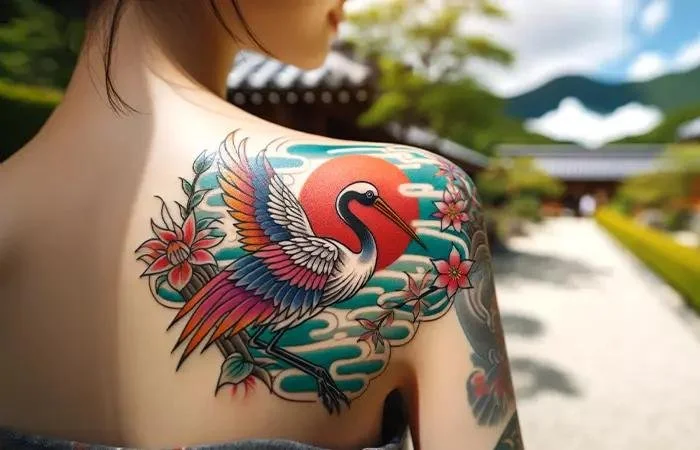
A crane flying across a rising sun is a classic visual subject in Japanese art. The sun can suggest renewal, warmth and the beginning of another day. Combined with the crane’s auspicious associations, the composition can express hope, good fortune and a positive new beginning.
How Should You Design a Japanese Crane Tattoo?
Begin by identifying the meaning that matters most. Is your crane about a long life, a loyal relationship, a loved one, peace or a new beginning?
Then build the composition around that story. Consider:
• One crane or two: Individual aspiration versus companionship.
• Flying or standing: Movement and possibility versus calmness and stability.
• Pine or cherry blossom: Longevity versus life’s fleeting beauty.
• Natural crane or origami crane: Traditional auspicious symbolism versus wishes, remembrance and peace.
• Fine-line or traditional Japanese style: A delicate standalone image versus a larger connected composition.
A meaningful design doesn’t need every symbol at once. Sometimes one carefully positioned crane tells the story more clearly than an overcrowded composition.
Is a Japanese Crane Tattoo Part of Traditional Irezumi?
Crane imagery belongs to the wider history of Japanese art and can be incorporated into traditional or Japanese-inspired tattoo compositions.
However, the crane is not automatically a traditional Irezumi design simply because the bird is culturally Japanese.
Traditional Japanese tattooing places considerable importance on how subjects, backgrounds and the body interact.
For example, a crane with pine trees and clouds can be developed into a connected Japanese-style composition, while a small origami crane may be better suited to minimalist tattooing.
Neither approach is inherently more meaningful.
What matters is choosing an artistic style that fits the story.
Đọc thêm: Irezumi Tattoo: The History and Art of Traditional Japanese Tattooing
Frequently Asked Questions About Japanese Crane Tattoo
1. What does a Japanese Crane Tattoo mean?
A Japanese Crane Tattoo commonly symbolizes longevity, loyalty, good fortune, peace and hope. The meaning depends on the bird’s pose, accompanying imagery and the wearer’s personal story.
2. What does a Japanese crane tattoo mean for couples?
A pair of cranes can represent lasting love, faithfulness and mutual support. Red-crowned cranes are known for long-term pair bonding, helping explain their association with devoted relationships.
Highlighting Japan
3. What does a Japanese crane and cherry blossom tattoo mean?
It can represent the relationship between longevity and impermanence: hoping for a long life while appreciating its fleeting, beautiful moments.
4. What does a Japanese crane and pine tree tattoo mean?
The pairing traditionally expresses longevity and good fortune. Both cranes and evergreen pines appear in Japanese auspicious art.
5. What does an origami crane tattoo symbolize?
Origami cranes can represent wishes, hope, peace, healing and remembrance. Their modern association with peace is strongly connected to Sadako Sasaki and the Children’s Peace Monument in Hiroshima.
6. Is a Japanese Crane Tattoo good luck?
Yes. Cranes are longstanding auspicious symbols in Japanese art, often appearing in compositions expressing wishes for happiness, long life and prosperity.
7. Can a Japanese Crane Tattoo be done in fine-line style?
Yes. Its elegant anatomy suits fine-line and illustrative tattooing. However, the artist should preserve enough spacing and contrast for the design to remain readable after healing and aging.
Final Thoughts: What Does a Japanese Crane Tattoo Represent?
A Japanese Crane Tattoo is a symbol of the things we hope will endure: life, love, loyalty and good fortune. Its meaning can be peaceful, deeply personal or connected to centuries of Japanese artistic tradition.
Whether you choose a pair of cranes, a bird flying toward the sun or a simple origami crane, the most meaningful design is one that connects the symbolism to your own story.
The crane reminds us that a meaningful life is not only about how long we live, but also what we carry through it.
Create Your Japanese Crane Tattoo in Hanoi
Inspired by the elegance and symbolism of Japanese cranes?
At 3 of Spades Hanoi Tattoo, our artists can help develop a custom crane tattoo around your story, preferred style, placement and body composition.
Send us your reference images, approximate size, preferred placement and Hanoi travel dates to begin your consultation.
Every tattoo has a story. Let’s create yours.