
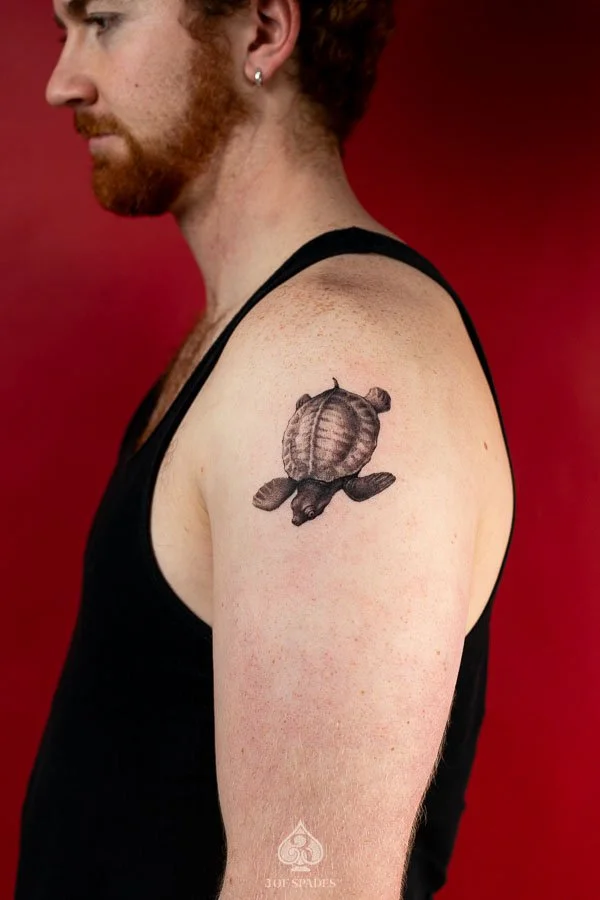
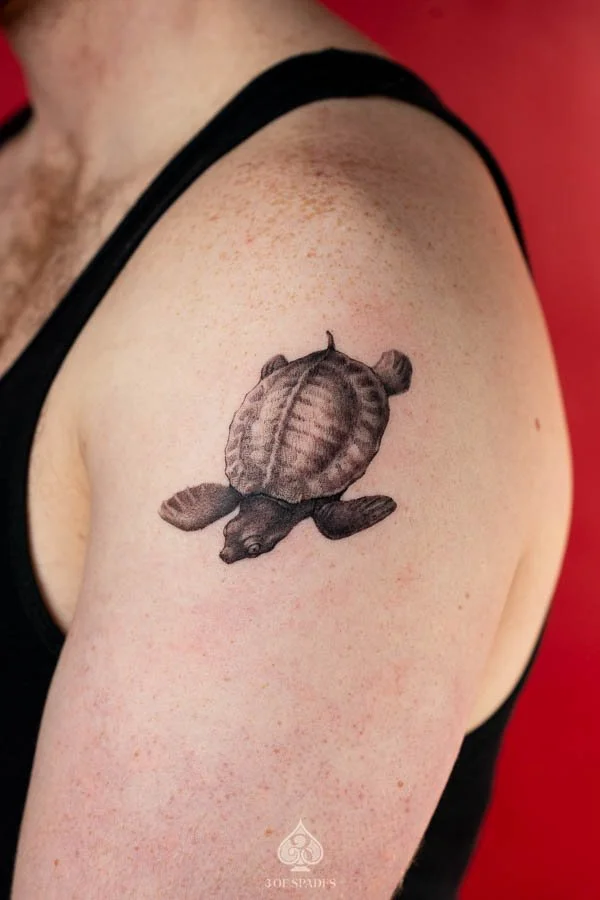
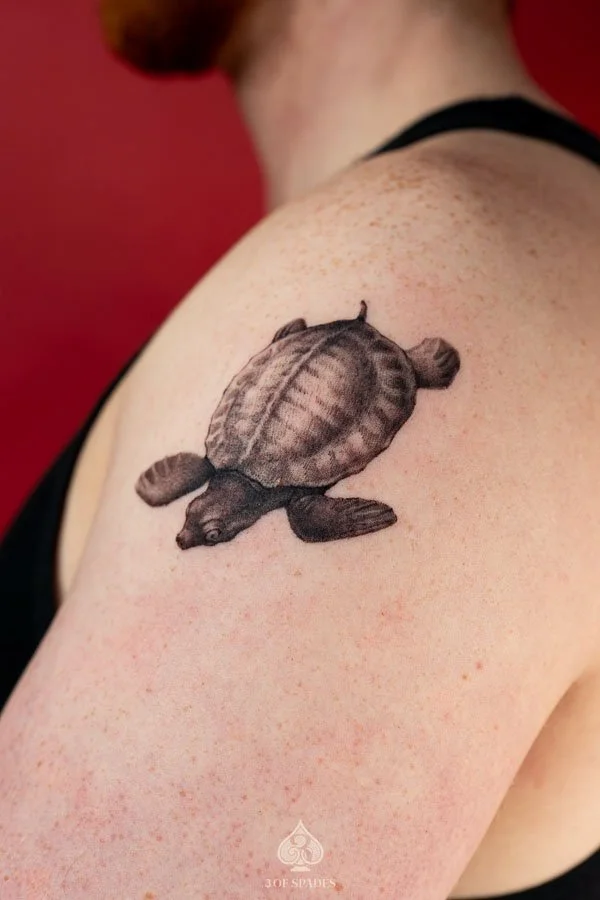
Realism Sea Turtle Tattoo: Lifelike Marine Art & Ocean Symbolism | 3 of Spades Hanoi Tattoo
Realism Sea Turtle Tattoo designs capture the remarkable beauty of marine wildlife through detailed anatomy, natural shading, and carefully rendered textures. From the intricate patterns of a sea turtle’s shell to the graceful movement of its flippers, realistic tattooing transforms an ocean creature into a distinctive piece of body art.
Sea turtles are among the ocean’s most recognizable animals. Their long migrations, streamlined bodies, and calm underwater movements have inspired artwork across different cultures and artistic traditions.
A realistic sea turtle tattoo focuses on preserving these recognizable characteristics rather than exaggerating them into cartoon-like shapes.
At 3 of Spades Hanoi Tattoo, sea turtle designs can be developed around individual references, preferred tattoo techniques, and placement. Whether you prefer detailed black-and-grey realism or natural color, the artwork can reflect your appreciation for marine life and the ocean.
For ocean lovers, divers, travelers, and wildlife enthusiasts, a sea turtle tattoo can become a meaningful reminder of the natural world.
What Makes a Realism Sea Turtle Tattoo Unique?
A Realism Sea Turtle Tattoo emphasizes anatomical accuracy, natural proportions, and carefully developed textures.
Unlike simplified turtle illustrations, realistic artwork aims to recreate the visual characteristics of an actual sea turtle.
Important design features include:
• Detailed Shell Patterns: Individual scutes create recognizable geometric structures across the turtle’s shell.
• Natural Flipper Anatomy: Long, paddle-like front flippers establish the sea turtle’s distinctive silhouette.
• Realistic Head Structure: Carefully shaped eyes, beak, and facial contours give the animal character.
• Textured Skin: Small scales and irregular markings add visual complexity.
• Dimensional Shading: Gradual tonal transitions create the impression of depth.
• Natural Movement: Swimming poses can make the turtle appear to glide through water.
• Balanced Contrast: Dark and light areas help separate the shell, body, and flippers.
• Wildlife-Inspired Composition: The design prioritizes recognizable animal anatomy.
The challenge of realism tattooing lies in combining these details without overcrowding the composition.
What Does a Realism Sea Turtle Tattoo Symbolize?
A Realism Sea Turtle Tattoo can represent longevity, endurance, freedom, resilience, and a personal connection to the ocean.
Sea turtles travel long distances during their lives, making them an appealing subject for people who associate the ocean with exploration and perseverance.
Common symbolic interpretations include:
• Longevity: Sea turtles can live for many decades, making them a popular symbol of long life.
• Endurance: Their migrations evoke persistence through difficult journeys.
• Freedom: Swimming through open water can represent independence and exploration.
• Resilience: Sea turtles face numerous challenges throughout their life cycle.
• Connection to Nature: The animal can symbolize appreciation for marine ecosystems.
• Personal Growth: A turtle’s journey from hatchling to adult can evoke transformation.
• Calmness: Their graceful underwater movements can represent peace and emotional balance.
• Protection: Turtle shells are sometimes interpreted as symbols of safety and security.
These meanings are personal interpretations rather than universal definitions. A sea turtle tattoo can also simply celebrate a favorite animal or a memorable ocean encounter.
Why Are Sea Turtles Popular in Realism Tattoo Art?
Sea turtles are especially suitable for realism tattooing because of their distinctive anatomy and detailed natural textures.
Their bodies offer a combination of geometric shell patterns and organic forms.
Intricate Shell Structure
A sea turtle’s upper shell, known as the carapace, provides one of the most recognizable elements of the animal.
Its patterned scutes create opportunities for detailed shading and texture.
Different sea turtle species have different shell characteristics, so accurate references are important.
Expressive Facial Details
Sea turtles have distinctive eyes, beaks, and head shapes.
Subtle shading around these features can make the animal appear more lifelike.
Graceful Swimming Movement
Sea turtles use their front flippers to move through water.
A swimming pose can create a dynamic composition that works particularly well on the arm, shoulder, or leg.
Natural Surface Textures
Scales, shell markings, and skin folds introduce variation.
These details help distinguish realistic artwork from simplified illustrations.
Strong Silhouette
Even without a background, a sea turtle has a recognizable shape.
This allows the animal to function as a standalone tattoo.
How Do Artists Create a Realism Sea Turtle Tattoo?
Creating a Realism Sea Turtle Tattoo involves translating a three-dimensional animal into a tattoo using shading, texture, contrast, and anatomical detail.
The exact process depends on the artist’s technique and the chosen reference.
Selecting an Accurate Reference
Clear reference images help establish the turtle’s anatomy.
The artist considers the shell, head, flippers, and overall proportions before developing the composition.
Establishing the Silhouette
The turtle’s outline needs to remain recognizable.
A strong silhouette is especially important when the design includes detailed shading.
Building Shell Texture
The shell contains distinct patterns that vary by species.
Carefully planned tonal differences can help individual scutes remain visible.
Developing Natural Shading
Realism tattooing often relies on gradual transitions between dark, medium, and light tones.
These transitions create depth around the shell and body.
Rendering Flippers and Skin
The flippers require attention to anatomy and surface texture.
Natural markings and controlled shading help create a believable appearance.
Preserving Negative Space
Not every part of the tattoo needs to be heavily shaded.
Open areas can provide highlights and prevent the design from appearing visually crowded.
What Are the Best Realism Sea Turtle Tattoo Styles?
A Realism Sea Turtle Tattoo can be interpreted through several techniques.
Black and Grey Realism
Black-and-grey realism uses different tonal values to recreate the animal’s anatomy and textures.
This approach emphasizes contrast, shading, and dimensional detail.
Color Realism
Color realism incorporates natural greens, browns, greys, and other tones depending on the turtle species.
Subtle color variation can enhance the appearance of the shell and skin.
Micro-Realism Sea Turtle Tattoo
Micro-realism attempts to recreate detailed subjects at relatively small sizes.
However, the artist must simplify certain details to maintain clarity as the tattoo ages.
Fine Detail Wildlife Tattoo
Fine detail artwork emphasizes intricate markings and controlled shading.
It may combine realistic textures with a slightly illustrative approach.
Realistic Underwater Composition
A sea turtle can be incorporated into a larger ocean scene featuring water, coral, or other marine elements.
Minimal Background Realism
A standalone sea turtle can be rendered realistically without a detailed underwater environment.
This keeps attention on the animal’s anatomy and movement.
What Are Popular Realism Sea Turtle Tattoo Ideas?
A Realism Sea Turtle Tattoo offers several creative possibilities through different poses, perspectives, and compositions.
Popular ideas include:
• Swimming Sea Turtle Tattoo: A turtle gliding through water with extended front flippers.
• Top-View Sea Turtle Tattoo: A composition emphasizing the shell and symmetrical body shape.
• Black and Grey Sea Turtle Tattoo: Detailed anatomy created through tonal shading.
• Color Realism Turtle Tattoo: Naturalistic colors inspired by marine wildlife.
• Sea Turtle Forearm Tattoo: A vertical swimming composition adapted to the arm.
• Small Realistic Turtle Tattoo: A compact design with carefully selected details.
• Sea Turtle and Coral Tattoo: A marine composition featuring reef elements.
• Sea Turtle and Ocean Waves Tattoo: A design connecting the animal with moving water.
• Sea Turtle Shoulder Tattoo: A rounded composition following the shoulder’s shape.
• Underwater Sea Turtle Tattoo: A larger scene featuring depth and atmospheric shading.
• Sea Turtle Portrait Tattoo: A close-up emphasizing the head, eyes, and shell.
• Sea Turtle Travel Tattoo: Artwork commemorating a meaningful ocean experience.
Each design can be personalized according to the desired placement, size, and artistic style.
Which Sea Turtle Species Can Inspire a Realism Tattoo?
Different sea turtle species have distinctive anatomical characteristics.
Choosing a particular species can make a Realism Sea Turtle Tattoo more accurate and personal.
Green Sea Turtle
Green sea turtles have smooth, oval-shaped shells and relatively small heads.
They are frequently photographed in tropical marine environments.
Hawksbill Sea Turtle
Hawksbill turtles have distinctive pointed beaks and overlapping shell scutes.
Their intricate shell patterns can inspire highly detailed tattoo artwork.
Loggerhead Sea Turtle
Loggerheads have relatively large heads and powerful jaws.
Their recognizable proportions can create a distinctive realistic composition.
Leatherback Sea Turtle
Leatherbacks differ from other sea turtles because they lack a typical hard shell covered in scutes.
Their ridged, leathery backs create a unique texture for realism artwork.
Olive Ridley Sea Turtle
Olive ridleys are generally smaller sea turtles with rounded shells.
They can inspire compact, naturalistic compositions.
For species-specific tattoos, using accurate photographic references helps preserve important anatomical differences.
Why Choose the Forearm for a Realism Sea Turtle Tattoo?
The forearm is a popular placement for a Realism Sea Turtle Tattoo because it offers a relatively accessible canvas for detailed animal artwork.
A swimming turtle can be arranged vertically along the arm, allowing the flippers and shell to follow the body’s natural shape.
Advantages include:
• Vertical Composition: Suitable for swimming poses.
• Good Visibility: The tattoo can be easily displayed.
• Space for Detail: Medium-sized designs can accommodate shell patterns and shading.
• Natural Movement: The turtle’s body can follow the direction of the forearm.
• Flexible Sizing: The artwork can be adapted to different arm dimensions.
• Future Expansion: Additional marine elements can potentially be incorporated later.
The final placement should consider the size of the turtle and the amount of detail required.
Where Else Can You Place a Realism Sea Turtle Tattoo?
A Realism Sea Turtle Tattoo can suit several body areas.
• Upper Arm: Suitable for medium-sized detailed turtles.
• Shoulder: Works well for rounded shell compositions.
• Calf: Provides vertical space for swimming turtles.
• Thigh: Offers a broad canvas for realistic textures and underwater scenes.
• Upper Back: Suitable for larger wildlife compositions.
• Chest: Allows a turtle to be incorporated into a wider design.
• Back of the Arm: A discreet location for a compact sea turtle.
• Forearm: A versatile placement for visible marine artwork.
Realism tattoos often benefit from sufficient space to preserve important anatomical details.
How Can You Personalize Your Realism Sea Turtle Tattoo?
A Realism Sea Turtle Tattoo can be customized through species selection, pose, shading, color, and placement.
Consider the following choices:
• Select a Species: Choose a green sea turtle, hawksbill, loggerhead, or another species.
• Choose the Perspective: Explore top-view, side-view, or three-quarter compositions.
• Adjust the Swimming Pose: Position the flippers to create movement.
• Decide on Color: Use black and grey or naturalistic color.
• Add Ocean Elements: Incorporate subtle water textures, coral, or reef details.
• Include Personal Memories: Use references from a diving or snorkeling experience.
• Choose the Size: Allow enough room for shell patterns and facial details.
• Consider Negative Space: Avoid overcrowding the composition.
• Plan the Placement: Adapt the design to the forearm, shoulder, calf, or thigh.
At 3 of Spades Hanoi Tattoo, our artists can help develop a custom sea turtle composition based on your preferred references.
Is a Realism Sea Turtle Tattoo a Good Travel Souvenir?
A Realism Sea Turtle Tattoo can be a meaningful travel souvenir for people who associate their journeys with the ocean.
Vietnam’s coastal regions and islands are home to marine environments where sea turtles are an important part of conservation efforts.
For travelers, a sea turtle tattoo may commemorate:
• A memorable snorkeling experience.
• A diving trip.
• A meaningful beach holiday.
• An encounter with marine wildlife.
• A personal connection to the ocean.
• A journey through Southeast Asia.
• An interest in marine conservation.
• A significant life milestone.
A realistic design can preserve the recognizable appearance of an animal connected to a memorable experience.
How Do You Care for a Realism Sea Turtle Tattoo?
A Realism Sea Turtle Tattoo requires appropriate aftercare to protect its shading, textures, and fine anatomical details.
Because realistic artwork often contains subtle tonal transitions, long-term skin care is important.
• Follow Artist Instructions: Use the recommended cleaning and moisturizing routine.
• Keep the Tattoo Clean: Wash gently according to your artist’s guidance.
• Avoid Scratching: Allow peeling skin to shed naturally.
• Reduce Friction: Avoid clothing or accessories that repeatedly rub against the fresh tattoo.
• Avoid Swimming: Do not submerge the tattoo until it has healed.
• Protect Healing Skin: Minimize direct sunlight during recovery.
• Use Sunscreen After Healing: Sun protection can help reduce long-term fading.
• Avoid Picking at Scabs: Allow the skin to recover naturally.
• Monitor Healing: Seek medical advice if you notice spreading redness, worsening pain, pus, or fever.
If you are planning ocean activities during your trip, consider scheduling your tattoo after swimming and diving.
Why Choose 3 of Spades Hanoi Tattoo for Wildlife Realism?
A Realism Sea Turtle Tattoo requires attention to anatomy, texture, contrast, and the relationship between detailed shading and body placement.
At 3 of Spades Hanoi Tattoo, our artists develop custom tattoo artwork based on individual references, preferred styles, and placement.
Our studio offers:
• Custom Wildlife Designs: Explore personalized marine animal compositions.
• Black and Grey Tattooing: Develop dimensional shading and natural textures.
• Color Tattoo Options: Incorporate naturalistic tones when appropriate.
• Detailed Animal Artwork: Create recognizable anatomy and expressive compositions.
• Personalized Placement: Adapt the design to your preferred body area.
• English-Speaking Artists: Discuss your tattoo ideas comfortably in English.
• Hanoi Old Quarter Location: Visit our studio while exploring central Hanoi.
Whether you prefer a standalone realistic sea turtle or a larger underwater composition, our team can help you explore a design suited to your preferences.
Realism Sea Turtle Tattoo FAQ
1. What does a Realism Sea Turtle Tattoo symbolize?
A Realism Sea Turtle Tattoo can symbolize longevity, endurance, freedom, resilience, and a personal connection to the ocean.
2. What is the difference between a sea turtle and a freshwater turtle tattoo?
Sea turtles have long, paddle-like flippers adapted for swimming in marine environments. Freshwater turtles generally have different limb structures and shell characteristics.
3. Is black and grey suitable for a Realism Sea Turtle Tattoo?
Yes. Black-and-grey shading can create detailed shell textures, natural anatomy, and dimensional contrast without using color.
4. Can a sea turtle tattoo be done in color realism?
Yes. Natural greens, browns, greys, and other tones can be used to recreate the appearance of different sea turtle species.
5. What is the best placement for a Realism Sea Turtle Tattoo?
The forearm, upper arm, shoulder, calf, thigh, and upper back are suitable options. The best placement depends on the design’s size and detail.
6. Can a realistic sea turtle tattoo be small?
Yes, but the artist may need to simplify certain textures and anatomical details to maintain clarity over time.
7. How long does a Realism Sea Turtle Tattoo take?
The duration depends on the size, complexity, shading, color, and placement. Highly detailed designs may require several hours or multiple sessions.
8. Can I use my own underwater photograph as a tattoo reference?
Yes. A clear photograph from a diving or snorkeling experience can provide a meaningful starting point for a custom design.
9. Do realistic sea turtle tattoos age well?
Realism tattoos can age well when designed with appropriate contrast, sufficient spacing, and thoughtful placement. All tattoos change over time, and very fine details may soften.
10. How much does a Realism Sea Turtle Tattoo cost in Hanoi?
Pricing depends on the tattoo’s dimensions, complexity, placement, and technique. Contact 3 of Spades Hanoi Tattoo with your references for a personalized quotation.
Book Your Realism Sea Turtle Tattoo at 3 of Spades Hanoi Tattoo
A Realism Sea Turtle Tattoo celebrates the beauty of marine wildlife through detailed anatomy, natural shading, and expressive movement.
From the intricate patterns of a turtle’s shell to its graceful swimming posture, realistic tattooing offers an opportunity to create artwork inspired by the ocean.
Whether your design represents a meaningful travel experience, an appreciation for marine conservation, or simply a love of sea turtles, it can be customized to reflect your personal story.
At 3 of Spades Hanoi Tattoo, our artists can help transform your references into a personalized wildlife tattoo.
Inspired by the ocean. Defined by detail. Carried for a lifetime.