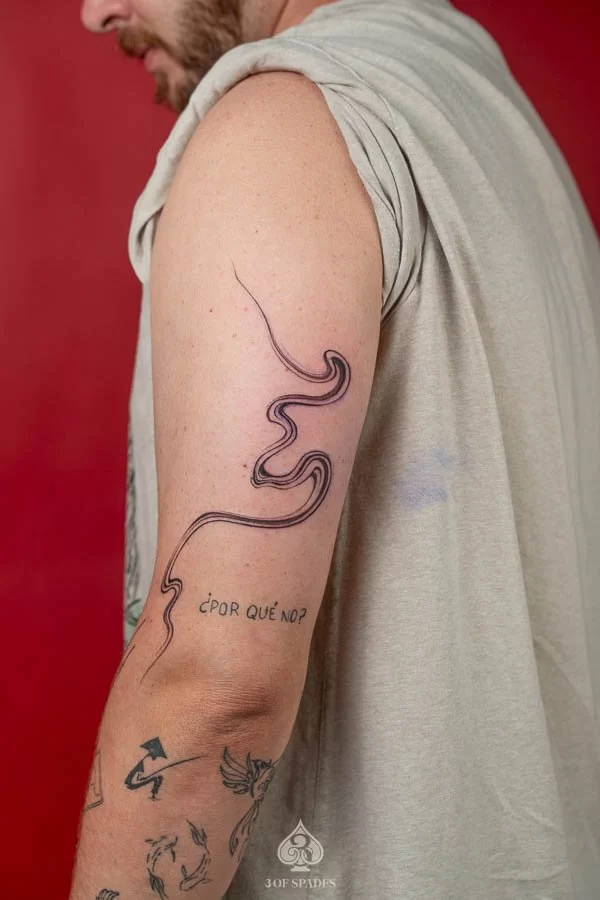

A Full Sleeve Tattoo is more than a large tattoo. It is a complete composition designed to flow across your shoulder, upper arm, elbow and forearm. Naturally, one of the first questions people ask before starting such a major project is:
How much does a full sleeve tattoo cost?
There isn’t one price that applies to every sleeve.
Two tattoos can cover almost exactly the same amount of skin yet require completely different amounts of work. A sleeve featuring large, open blackwork elements, for example, may involve a different process from a photorealistic composition filled with portraits, textures and intricate background details.
Your final price can depend on the size of your arm, tattoo style, complexity, amount of coverage, artist, number of sessions and whether existing tattoos need to be incorporated or covered.
Understanding these factors can help you create a realistic budget before beginning your project.


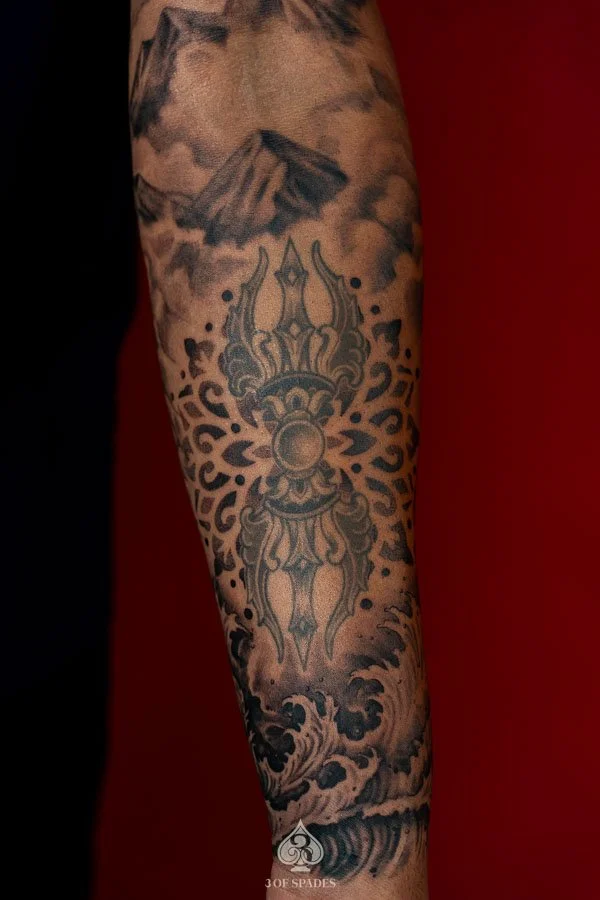
How Much Does a Full Sleeve Tattoo Cost?
A tattoo studio usually needs much more information than simply, “I want a sleeve,” before providing a useful estimate.
Consider two different projects. One client wants several large Japanese-inspired elements connected with waves and areas of negative space. Another wants a highly detailed realism sleeve containing portraits, architecture, jewelry, textures and a complete background.
Both tattoos may extend from shoulder to wrist, but the amount of design and tattooing work can be dramatically different.
8 Factors That Affect Full Sleeve Tattoo Cost
Several factors determine how much work goes into a sleeve. Understanding them can also help you decide where to adjust your project if you have a specific budget.
1. Full Sleeve Tattoo Size and Coverage

The first factor is how much of your arm will actually be tattooed. Although a traditional full sleeve generally extends from the shoulder toward the wrist, coverage varies significantly between designs.
Some sleeves incorporate substantial negative space. Others cover nearly every visible area with ink. Your individual anatomy matters as well. Arm length, circumference and muscle structure influence how the design needs to be scaled and positioned.
A larger tattooing area generally requires more work, but size isn’t the only factor. A large minimalist composition could potentially require less time than a smaller area filled with extremely detailed realism.
Price impact: Greater coverage generally increases tattooing time and overall cost.
2. Tattoo Style
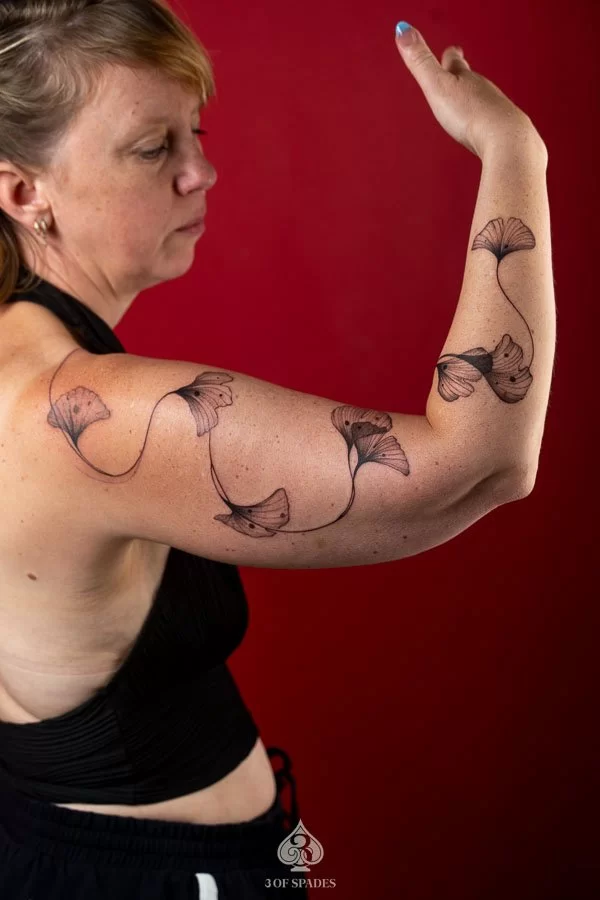


Your chosen style can significantly influence the amount of work involved. A realism sleeve may require detailed shading, subtle tonal transitions and precise textures. Japanese-style sleeves often involve large interconnected elements that need to flow naturally around the arm. Meanwhile, blackwork, fine-line, traditional, ornamental and illustrative sleeves each have their own technical requirements.
This means you shouldn’t compare two tattoo quotes based purely on the amount of skin being covered.
Price impact: Styles requiring extensive detail or technically demanding execution may require more design and tattooing time.
3. Design Complexity and Detail
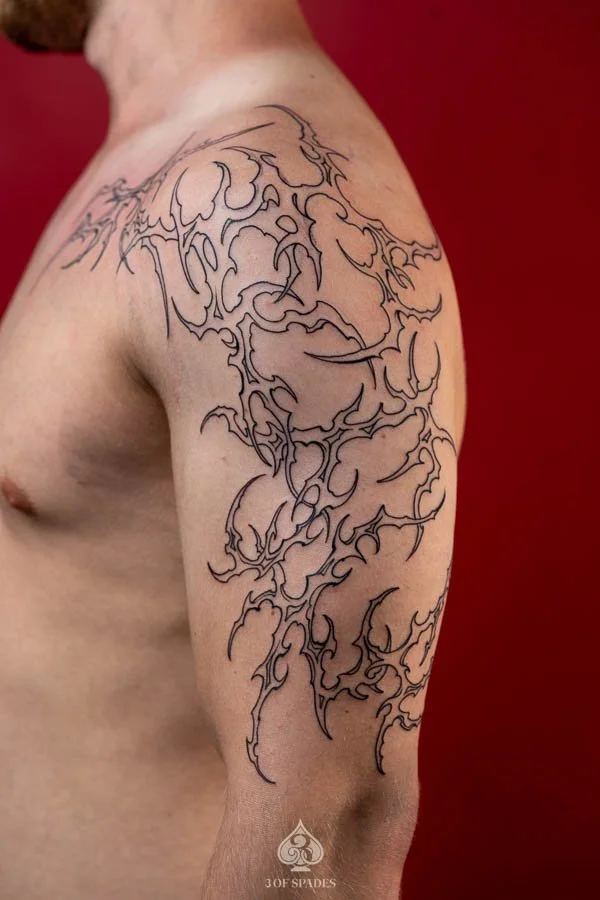


Imagine two sleeves of approximately the same size. The first contains several large flowers with relatively simple shading. The second includes a realistic portrait, animal fur, jewelry, architecture and a detailed background. Although their physical dimensions are similar, they don’t require the same amount of work.
Tiny textures, facial features, smooth gradients and complicated patterns all take time to execute. Complexity also affects the design stage. Your artist may need additional preparation to make multiple reference images work together as one composition.
Price impact: More intricate designs generally require additional preparation and tattooing time.
4. Black and Grey vs. Color


Clients sometimes assume that black and grey sleeves are automatically cheaper than color sleeves. That isn’t necessarily true.
A color tattoo may require multiple pigments, careful saturation and complex transitions. However, an extremely detailed black and grey realism sleeve can also require extensive shading and precision. For example, a relatively simple traditional color composition could require less work than a photorealistic black and grey portrait sleeve.
Therefore, color alone isn’t a reliable way to estimate price.
Price impact: Color can increase complexity in some projects, but style, detail and tattooing time are usually more important considerations.
5. Artist Experience and Specialization
Your artist is another major part of the price. Experienced tattoo artists may charge differently based on their expertise, specialization and demand.
With a Full Sleeve Tattoo, specialization becomes particularly important. If you want realism, examine artists who have strong realism portfolios. If you want Japanese tattooing, look for artists experienced in designing large Japanese compositions.
The same applies to blackwork, fine-line, ornamental and other styles. A sleeve isn’t simply a large image transferred onto your arm. Your artist needs to understand how artwork behaves across a three-dimensional surface that bends and moves.
Price impact: Experience, specialization and artist demand can influence pricing.
6. Number of Tattoo Sessions
Most complex sleeves require substantial tattooing time. Depending on the project, different sessions might focus on outlining, shading, color or specific sections of the arm. The appropriate number and length of appointments depend on your design, artist’s workflow, skin response and individual tolerance.
Larger projects may also require healing time between relevant stages. Trying to finish everything as quickly as possible isn’t always the best approach. Long sessions can be demanding for both the client and artist.
Price impact: More tattooing time and additional sessions generally increase the overall project cost.
7. Custom Design and Composition
A Full Sleeve Tattoo should ideally feel like one artwork rather than a random collection of images. That requires composition planning.
Your artist needs to decide where major elements should sit, how they interact with the shape of your arm and how transitions connect the shoulder, upper arm, elbow and forearm.
The artwork also needs to look balanced from multiple angles. If you’re combining several references, your artist may need to redesign individual elements so everything works together. That creative preparation is part of creating a custom sleeve.
Price impact: Highly customized and complicated compositions may require additional planning and design work.
8. Cover-Ups and Existing Tattoos
Planning a sleeve around existing tattoos can make the project more complicated. Your artist isn’t starting with completely blank skin.
Instead, they need to consider the existing tattoo’s shape, darkness, colors and location. Some sections may need heavier or strategically positioned elements to disguise old artwork. Other existing tattoos may be incorporated into the new composition rather than covered.
The possibilities depend heavily on what’s already on your arm. That’s why clear photographs of existing tattoos are essential when requesting an estimate for a cover-up sleeve.
Price impact: Cover-ups can require additional design planning and tattooing work.
Full Sleeve Tattoo Pricing: Hourly, Per Session or Per Project?
Tattoo studios don’t all price large projects in the same way. Understanding the pricing structure can make comparing estimates easier.
Hourly Pricing
Some artists charge according to the number of tattooing hours. This approach can work well when it’s difficult to predict exactly how long a complex project will take.
However, hourly rates shouldn’t be compared in isolation. Artists work at different speeds and use different techniques. Therefore, the artist with the lowest hourly rate won’t necessarily produce the lowest final project price.
Session-Based Pricing
Some studios price longer appointments by session. This can make budgeting easier because you know approximately what each appointment will cost.
However, the total number of sessions may still depend on how the project progresses.
Project-Based Estimates
For some sleeves, your artist may provide an estimated range for the complete project. Remember that an estimate isn’t necessarily a guaranteed fixed price.
Significant changes to the artwork, coverage or complexity can affect the final amount of work required. Before starting, ask what your estimate includes and what types of changes could affect it.
How Many Sessions Does a Full Sleeve Tattoo Need?
There is no standard number of sessions that applies to every sleeve. A relatively open design with large elements may require significantly less work than an extremely detailed realism project.
Your schedule depends on factors such as:
• Tattoo style.
• Amount of coverage.
• Level of detail.
• Black and grey versus color.
• Existing tattoos.
• Cover-up requirements.
• Your individual tolerance.
• Skin response.
• Your artist’s working process.
For larger projects, your artist may also recommend sufficient healing time before continuing certain areas. If you’re traveling to Hanoi specifically for your tattoo, communicate your arrival and departure dates before finalizing the project. This allows the studio to assess what can realistically be completed during your visit.
Planning a Full Sleeve Tattoo at 3 of Spades Hanoi Tattoo
A large-scale tattoo requires more preparation than simply choosing an image and arriving at the studio. At 3 of Spades Hanoi Tattoo, we recommend discussing the complete concept before estimating a complex sleeve.
If you’re visiting Hanoi for a limited time, contact our team in advance.
To help us understand your project, send:
• Your inspiration and reference images.
• Clear photographs of your entire arm.
• Photos from multiple angles if you already have tattoos.
• The main subjects you want included.
• Your preferred tattoo style.
• Whether you want black and grey or color.
• Your approximate arm dimensions if requested.
• Your available dates in Hanoi.
• Any tattoos you want covered or incorporated.
• Your approximate budget, if you already have one.
The more information we have, the easier it is to understand the scope of your project and discuss a realistic approach.
Frequently Asked Questions About Full Sleeve Tattoo Cost
1. How Much Does a Full Sleeve Tattoo Cost?
There isn’t one universal price.
The cost depends on factors including tattoo style, size, complexity, artist, tattooing time, number of sessions and whether cover-up work is required.
Send your artist clear references and photographs of your arm for a more relevant estimate.
2. Why Is a Full Sleeve Tattoo Expensive?
A Full Sleeve Tattoo can involve extensive custom design work and many hours of tattooing. The artist must also adapt the composition around your arm rather than simply reproducing a flat image.
3. Is a Black and Grey Sleeve Cheaper Than a Color Sleeve?
Not necessarily.
A highly detailed black and grey realism sleeve may require more work than a relatively simple color tattoo. Complexity and tattooing time are usually more useful considerations than color alone.
4. How Many Sessions Does a Full Sleeve Tattoo Take?
There is no fixed number. The answer depends on the design’s complexity, coverage, style, your individual tolerance, skin response and the artist’s workflow.
5. Does a Cover-Up Full Sleeve Tattoo Cost More?
It can. Cover-ups may require additional planning and specific design choices to work around existing ink.
The artist needs to see clear photographs of your existing tattoos before assessing the project.
6. Can I Complete a Full Sleeve Tattoo During a Trip to Hanoi?
Potentially, depending on the project and how long you’re staying. A complex sleeve may require multiple sessions and appropriate recovery time. Contact the studio before your trip with your references and exact travel dates so the project can be assessed realistically.
7. How Can I Get an Accurate Full Sleeve Tattoo Price?
Send the studio your reference images, preferred style, photos of your arm, existing tattoos, desired coverage and approximate dimensions.
For large custom work, an in-person consultation may also help the artist evaluate your anatomy and finalize the design.
Final Thoughts: What Are You Really Paying For?
When researching Full Sleeve Tattoo cost, it’s easy to focus on one number. But that number represents much more than ink.
A sleeve involves design, composition, technical execution, tattooing time and the experience required to transform an idea into artwork that flows naturally across your entire arm.
Size affects the price. Detail affects the price. Style, sessions and existing tattoos can affect it too. That’s why the best way to understand the cost of your sleeve is to start with the design you actually want. Then let your artist assess the work required to create it properly.
One Arm. One Canvas. Your Story.
Planning a Full Sleeve Tattoo during your Hanoi trip?
At 3 of Spades Hanoi Tattoo, we believe your body is your journal, and your tattoos are your story.
Send us your inspiration, preferred style, clear photos of your arm and your travel dates. If you already have tattoos that need to be incorporated or covered, include photos of those areas as well.
Every tattoo has a story. Let’s create yours.