Asian Dragon Arm Tattoo: Eastern Dragon Art & Symbolism | 3 of Spades Hanoi Tattoo
Asian Dragon Tattoo designs combine the powerful symbolism of Eastern dragons with elegant, flowing compositions. Known for their elongated bodies, expressive features, and intricate details, Asian dragons have inspired centuries of art across China, Japan, Vietnam, and other East Asian cultures.
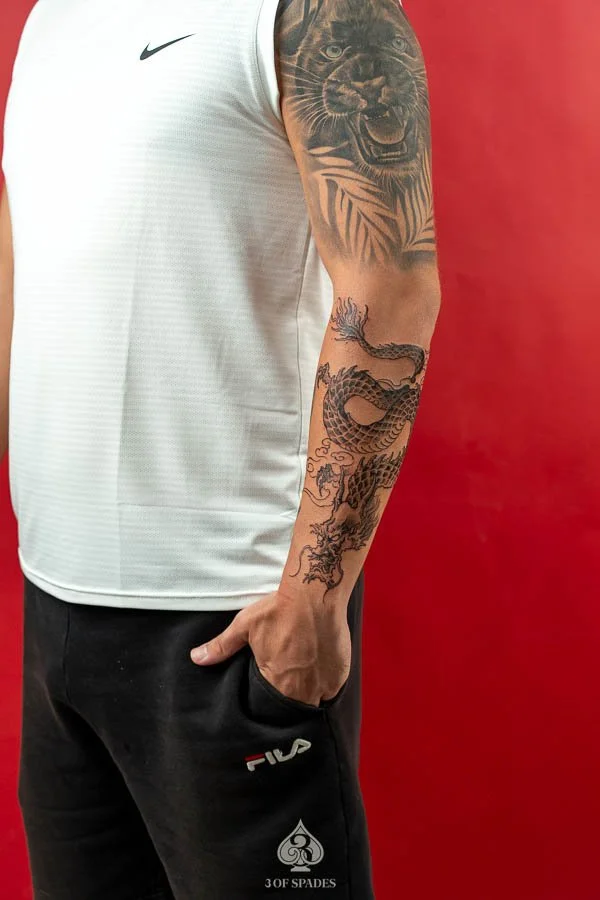
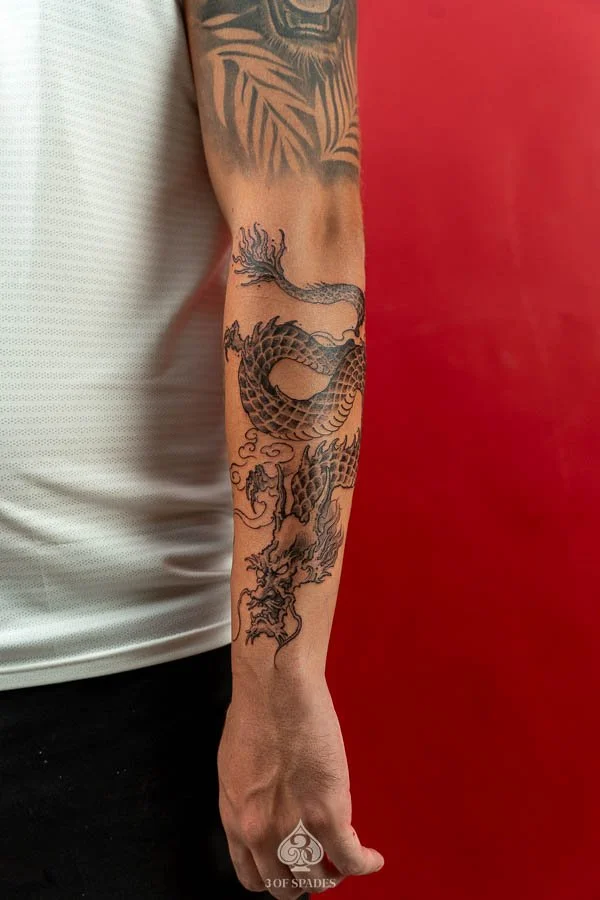
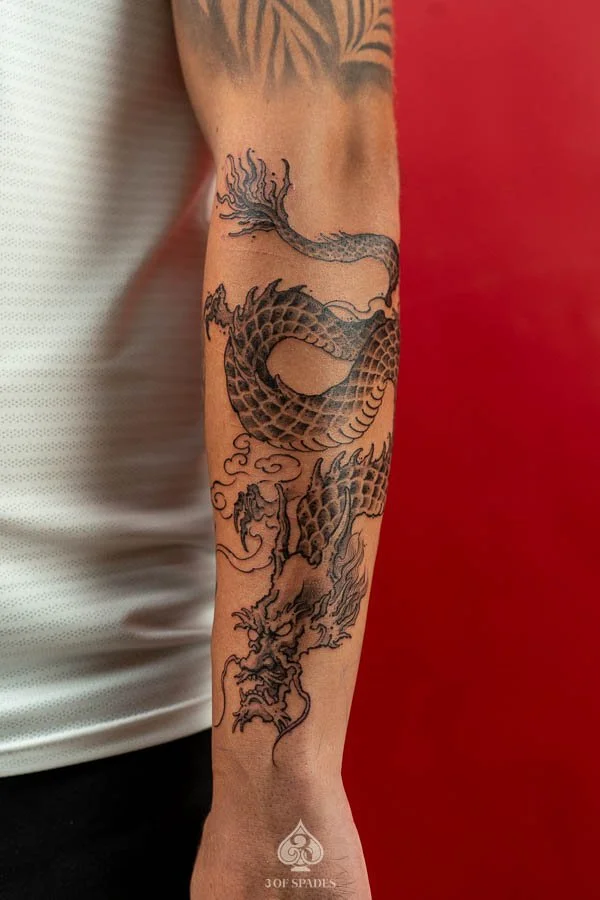
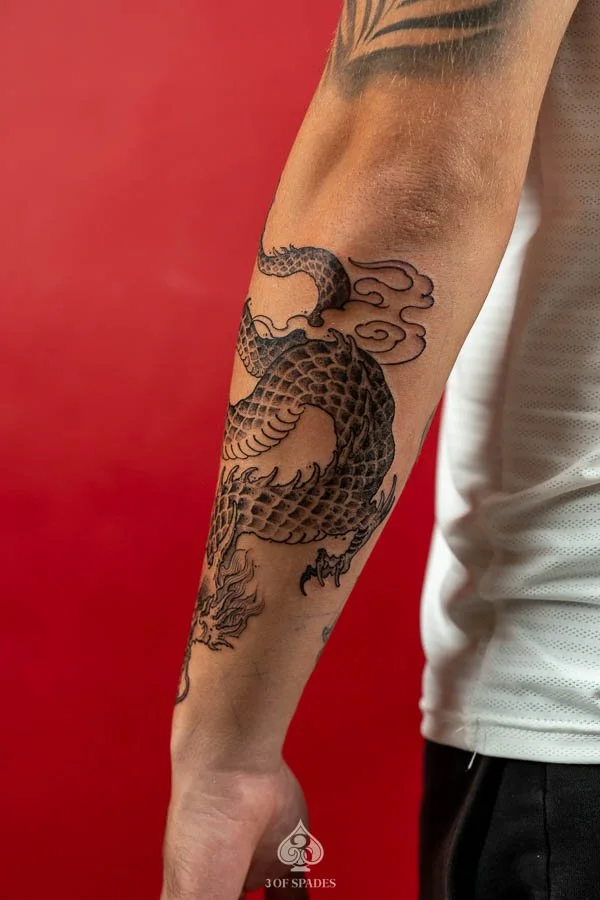
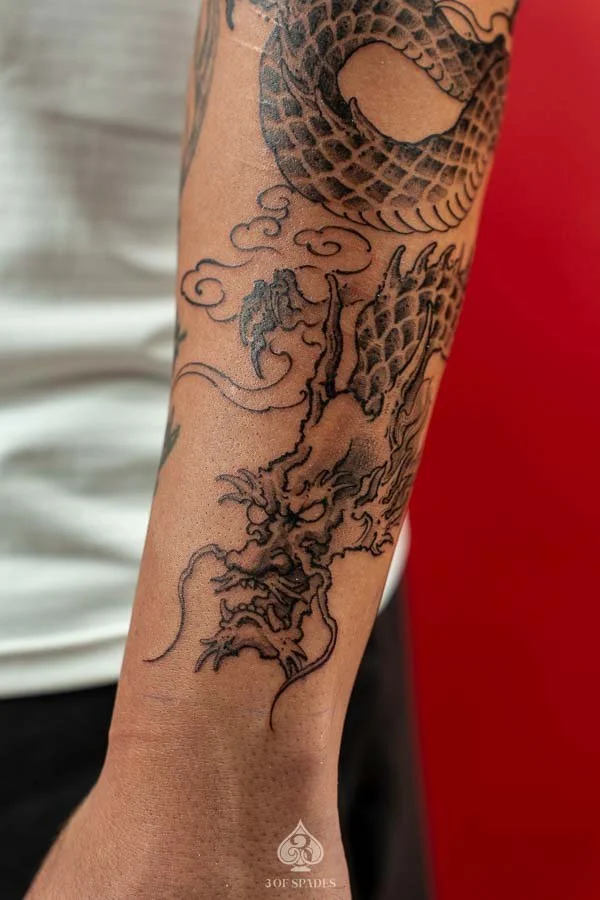
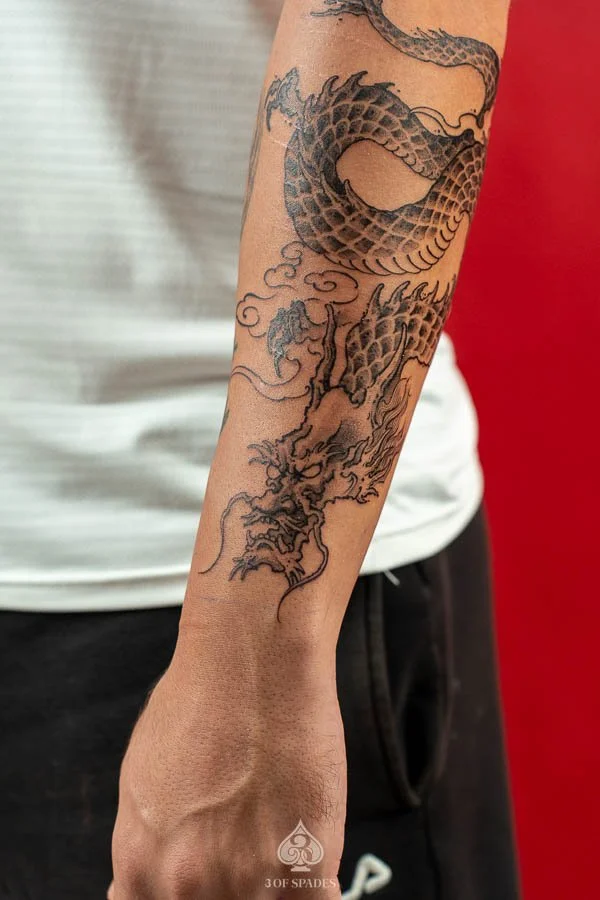
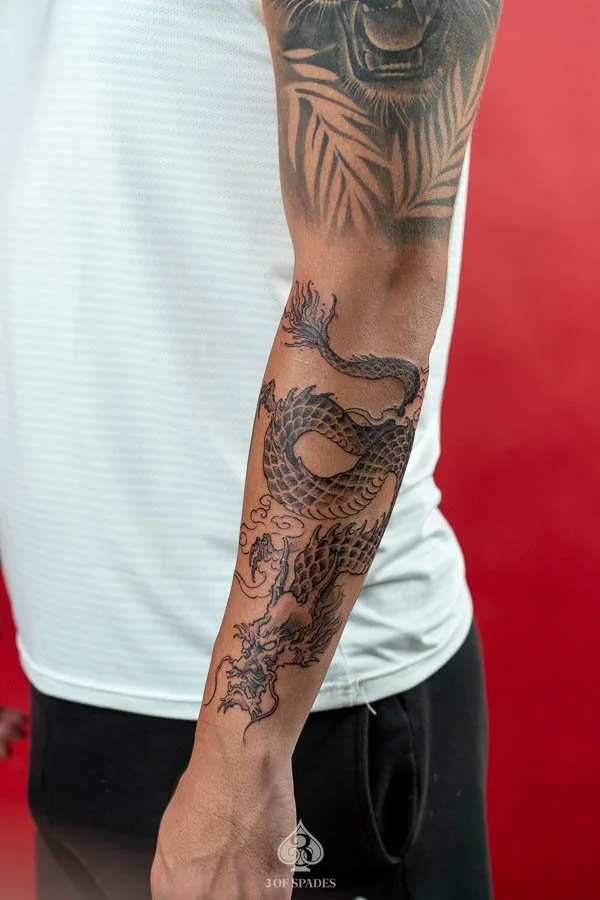
An Asian dragon arm tattoo transforms this legendary creature into a dynamic piece of body art. Its serpentine form can follow the natural contours of the arm, creating movement while allowing room for detailed scales, claws, horns, and decorative elements.
Unlike many Western dragon depictions, which commonly feature large wings, traditional East Asian dragons are frequently portrayed with long, winding bodies and distinctive facial features.
At 3 of Spades Hanoi Tattoo, our artists explore custom dragon designs inspired by traditional Asian imagery and contemporary tattoo aesthetics. Whether you prefer delicate illustration, black and grey shading, or bold blackwork, a dragon tattoo can be adapted to your personal style.
What Makes an Asian Dragon Tattoo Unique?
An Asian Dragon Tattoo stands out through its distinctive anatomy, expressive movement, and rich cultural associations.
Rather than appearing as a static creature, the dragon often twists, coils, or rises through the composition.
Key characteristics include:
• Serpentine Body: A long, winding form creates natural movement.
• Detailed Scales: Repeated patterns introduce texture and depth.
• Expressive Dragon Head: Horns, whiskers, and facial features establish character.
• Clawed Limbs: Decorative claws add strength and visual detail.
• Flowing Movement: The dragon’s body can curve naturally around the arm.
• Cultural Inspiration: The design references dragon imagery from East Asian artistic traditions.
• Flexible Artistic Styles: Dragons can be interpreted through fine line, blackwork, or illustrative techniques.
• Symbolic Meaning: Dragons may represent power, protection, prosperity, wisdom, or transformation.
These elements make dragon imagery particularly suitable for expressive arm compositions.
What Does an Asian Dragon Tattoo Symbolize?
An Asian Dragon Tattoo can represent strength, wisdom, protection, prosperity, and personal transformation.
However, dragon symbolism varies across cultures and historical contexts.
Strength and Power
Dragons are often associated with authority and extraordinary power.
For some wearers, the design represents confidence, determination, or the ability to overcome challenges.
Wisdom and Knowledge
In several East Asian traditions, dragons are connected with wisdom and supernatural abilities.
A dragon tattoo may symbolize personal growth or the pursuit of knowledge.
Protection
Dragons can appear as protective figures in mythology and decorative art.
This interpretation makes them meaningful symbols of guardianship.
Prosperity and Good Fortune
Dragon imagery is associated with auspicious qualities in many Chinese and Vietnamese traditions.
A dragon tattoo may represent hopes for success, prosperity, or favorable opportunities.
Transformation
The dragon’s dynamic movement can symbolize change and personal evolution.
The meaning ultimately depends on the wearer’s cultural references and personal interpretation.
What Is the Difference Between Asian and Western Dragon Tattoos?
Asian and Western dragon imagery often differ in anatomy, movement, and symbolic associations.
Asian Dragon Imagery
Traditional East Asian dragons commonly feature:
• Long serpentine bodies.
• Flowing whiskers.
• Decorative horns.
• Clawed limbs.
• Detailed scales.
• Cloud or water motifs.
• Wingless or minimally winged forms.
• Dynamic, winding movement.
These characteristics vary between Chinese, Japanese, Vietnamese, and other regional traditions.
Western Dragon Imagery
Western dragons are frequently depicted with:
• Large wings.
• Reptilian bodies.
• Powerful legs.
• Fire-breathing abilities.
• Armored scales.
• Fantasy-inspired anatomy.
Western dragon symbolism often emphasizes danger or conflict, although interpretations vary widely.
Both traditions offer creative possibilities for tattoo art.
How Do Chinese, Japanese, and Vietnamese Dragon Tattoos Differ?
An Asian Dragon Tattoo may draw inspiration from several regional artistic traditions.
Understanding their differences can help create a more culturally specific design.
Chinese Dragon Tattoo
Chinese dragons, commonly called long (龙), are associated with power, auspiciousness, and natural forces such as rain and water.
Traditional imagery often features elongated bodies, horns, whiskers, and claws.
Dragon designs may also reference historical imperial symbolism.
Japanese Dragon Tattoo
Japanese dragons, known as ryū (龍), frequently appear in traditional Japanese tattoo compositions.
They may be depicted among clouds, waves, and other natural elements.
Japanese dragon imagery often emphasizes flowing movement and expressive anatomy.
Vietnamese Dragon Tattoo
Vietnamese dragons, known as rồng, hold an important place in Vietnamese mythology, architecture, and decorative art.
Dragon imagery appears in historical temples, royal architecture, and traditional artistic motifs.
Different historical periods developed distinctive dragon forms.
Choosing a Cultural Reference
Rather than combining unrelated details without intention, a custom design can focus on a particular regional tradition or develop a contemporary interpretation inspired by several influences.
Why Is the Arm a Good Placement for an Asian Dragon Tattoo?
The arm provides an excellent canvas for the elongated form of an Asian dragon.
Its natural contours complement the dragon’s twisting body, creating opportunities for dynamic compositions.
Forearm
The forearm is suitable for a vertically arranged dragon.
Its length allows the body to flow naturally toward the wrist or elbow.
Upper Arm
The upper arm offers space for detailed dragon heads, scales, and decorative elements.
Outer Arm
The outer arm provides a visible placement for a dramatic dragon composition.
Inner Arm
The inner arm can accommodate a more delicate or compact interpretation.
Full Sleeve
A larger dragon can wrap around the arm and connect with waves, clouds, or ornamental backgrounds.
The ideal placement depends on the design’s size, direction, and complexity.
What Are Popular Asian Dragon Tattoo Styles?
An Asian Dragon Tattoo can be created through different artistic techniques.
Fine Line Dragon Tattoo
Fine line techniques emphasize delicate outlines and intricate anatomical details.
This approach works well for contemporary minimalist interpretations.
Blackwork Dragon Tattoo
Blackwork uses bold black ink and negative space to create striking contrast.
Black and Grey Dragon Tattoo
Black-and-grey techniques introduce shading and depth.
They can emphasize scales, facial features, and the dragon’s three-dimensional form.
Japanese-Inspired Dragon Tattoo
Japanese-inspired compositions may incorporate traditional visual elements such as waves, clouds, and expressive movement.
Illustrative Dragon Tattoo
Illustrative techniques allow for detailed, stylized interpretations.
Ornamental Dragon Tattoo
Ornamental compositions combine dragon imagery with decorative patterns and abstract shapes.
Each style creates a different visual character while preserving the dragon’s recognizable form.
How Does an Asian Dragon Tattoo Follow the Arm’s Anatomy?
An Asian Dragon Tattoo benefits from careful composition because its elongated body can follow the arm’s natural direction.
Curved Body Movement
The dragon’s body can twist around the forearm or upper arm.
Head Placement
The dragon’s head may serve as the central focal point near the shoulder, upper arm, or forearm.
Flowing Whiskers and Mane
Decorative facial details can extend into the surrounding space.
Tail Direction
The tail can guide the viewer’s eye along the arm.
Negative Space
Open areas help distinguish overlapping sections of the dragon’s body.
Scale Details
Repeated scale patterns introduce texture while reinforcing the creature’s anatomy.
A well-planned composition should remain recognizable from different viewing angles.
What Are Popular Asian Dragon Arm Tattoo Ideas?
An Asian Dragon Tattoo can be adapted to different dimensions, styles, and personal preferences.
Popular concepts include:
• Fine Line Asian Dragon: Delicate outlines with detailed scales.
• Blackwork Dragon Arm Tattoo: Bold black ink and graphic contrast.
• Chinese Dragon Forearm Tattoo: A design inspired by Chinese dragon imagery.
• Japanese Dragon Sleeve: A larger composition featuring traditional Japanese-inspired elements.
• Vietnamese Dragon Tattoo: Artwork inspired by Vietnamese historical dragon motifs.
• Minimalist Dragon Tattoo: A simplified serpentine dragon silhouette.
• Dragon and Clouds Tattoo: A dragon surrounded by decorative cloud patterns.
• Dragon and Waves Tattoo: A composition emphasizing movement and natural forces.
• Dragon Head Tattoo: A design focusing on expressive facial details.
• Coiling Dragon Tattoo: A dragon wrapping around the arm.
Each concept can be customized according to the wearer’s preferred aesthetic.
Can You Combine an Asian Dragon Tattoo with Other Symbols?
An Asian Dragon Tattoo can be incorporated into a larger composition featuring decorative or symbolic elements.
Popular combinations include:
• Clouds: Introduce atmospheric movement.
• Waves: Complement the dragon’s flowing body.
• Lotus Flowers: Add botanical imagery.
• Cherry Blossoms: Introduce seasonal decorative elements.
• Peonies: Create a floral contrast with the dragon.
• Geometric Patterns: Add structured decorative details.
• Ornamental Frames: Create a defined composition.
• Traditional Architecture: Reference regional cultural imagery.
• Abstract Blackwork: Introduce contemporary artistic elements.
The strongest compositions preserve a clear focal point while maintaining visual balance.
How Can You Personalize Your Asian Dragon Arm Tattoo?
An Asian Dragon Tattoo can be customized through anatomy, movement, shading, and cultural references.
Consider these options:
• Dragon Style: Choose Chinese, Japanese, Vietnamese, or contemporary-inspired imagery.
• Body Position: Explore coiling, rising, or flowing arrangements.
• Head Expression: Select a calm, fierce, or stylized appearance.
• Scale Details: Choose intricate patterns or simplified textures.
• Tattoo Technique: Explore fine line, blackwork, or black and grey shading.
• Supporting Elements: Add clouds, waves, flowers, or ornamental details.
• Placement: Adapt the composition to the forearm, upper arm, or full sleeve.
• Personal Meaning: Connect the dragon to strength, wisdom, protection, or transformation.
At 3 of Spades Hanoi Tattoo, our artists can help develop a custom dragon composition based on your references.
How Long Does an Asian Dragon Arm Tattoo Take?
The duration of an Asian Dragon Tattoo depends on its dimensions, complexity, and technique.
A small fine line dragon may require less time than a detailed full-arm composition.
Factors affecting session length include:
• Overall tattoo size.
• Dragon anatomy.
• Scale detailing.
• Linework complexity.
• Shading requirements.
• Background elements.
• Placement.
• Individual comfort.
Larger compositions may require multiple sessions.
Your artist can provide a more accurate estimate after reviewing the design.
How Do You Care for an Asian Dragon Arm Tattoo?
An Asian Dragon Tattoo requires appropriate aftercare to support healing and protect its details.
• Follow Artist Instructions: Use the recommended cleaning and moisturizing routine.
• Keep the Tattoo Clean: Wash gently according to your aftercare guidance.
• Avoid Scratching: Allow peeling skin to shed naturally.
• Reduce Friction: Avoid clothing or accessories that repeatedly rub against the healing tattoo.
• Avoid Swimming: Do not submerge the tattoo until it has healed.
• Limit Sun Exposure: Protect healing skin from direct sunlight.
• Moisturize Appropriately: Use the recommended amount of aftercare product.
• Use Sunscreen After Healing: Sun protection helps reduce long-term fading.
• Monitor for Problems: Seek medical attention if you notice spreading redness, worsening pain, pus, or fever.
Careful aftercare supports the healing process and helps maintain the clarity of detailed scales and ornamental elements.
Why Choose 3 of Spades Hanoi Tattoo for Dragon Artwork?
An Asian Dragon Tattoo requires careful attention to anatomy, composition, and cultural inspiration.
At 3 of Spades Hanoi Tattoo, our artists develop custom designs based on individual references and preferred artistic styles.
Our studio offers:
• Custom Dragon Designs: Personalized artwork developed from your references.
• Asian-Inspired Tattoo Art: Explore Chinese, Japanese, and Vietnamese dragon imagery.
• Fine Line Tattooing: Delicate outlines and intricate details.
• Blackwork Tattooing: Bold black ink and graphic contrast.
• Black and Grey Artwork: Detailed shading and expressive compositions.
• Personalized Placement: Adapt the dragon to the natural contours of the arm.
• English-Speaking Artists: Discuss your tattoo ideas comfortably in English.
• Hanoi Old Quarter Location: Visit our studio while exploring the historic center of Hanoi.
Whether you prefer a minimalist dragon or an elaborate arm composition, our team can help transform your ideas into personalized artwork.
Asian Dragon Tattoo FAQ
1. What does an Asian Dragon Tattoo symbolize?
An Asian Dragon Tattoo can symbolize strength, wisdom, protection, prosperity, or personal transformation. Meanings vary across cultural traditions.
2. What is the difference between Chinese and Japanese dragon tattoos?
Chinese and Japanese dragons share historical artistic influences but differ in their regional traditions, visual conventions, and tattoo compositions.
3. Are Vietnamese dragon tattoos different?
Yes. Vietnamese dragon imagery has distinctive historical forms and cultural associations, particularly in architecture and decorative art.
4. Is the arm a good placement for a dragon tattoo?
Yes. The arm’s elongated shape complements the flowing body of an Asian dragon.
5. Can an Asian Dragon Tattoo be done in fine line?
Yes. Fine line techniques can create delicate dragon outlines and detailed scales, provided the design is sized appropriately.
6. What direction should a dragon tattoo face?
There is no universal rule. The direction can be chosen according to the composition, placement, cultural reference, and personal preference.
7. Can I combine a dragon with clouds or waves?
Yes. Clouds and waves are common decorative elements in East Asian-inspired dragon compositions.
8. Are Asian dragon tattoos suitable for small designs?
Yes, although smaller designs may require simplified scales and facial details to preserve clarity.
9. How long does an Asian Dragon Arm Tattoo take?
The duration depends on size, complexity, shading, and placement. Larger designs may require multiple sessions.
10. How much does an Asian Dragon Tattoo cost in Hanoi?
Pricing depends on dimensions, complexity, placement, and technique. Contact 3 of Spades Hanoi Tattoo with your references for a personalized quotation.
Book Your Asian Dragon Arm Tattoo at 3 of Spades Hanoi Tattoo
An Asian Dragon Tattoo combines dynamic movement with cultural symbolism and expressive artistic detail.
From flowing serpentine bodies to intricate scales and powerful dragon heads, these designs offer endless possibilities for custom tattoo art.
Whether you’re inspired by Chinese, Japanese, or Vietnamese dragon traditions, the arm provides a versatile canvas for a personalized composition.
At 3 of Spades Hanoi Tattoo, our artists can help transform your references into custom dragon artwork suited to your preferred style and placement.
Ancient symbolism. Flowing movement. Timeless dragon art.
Book Your Tattoo at 3 of Spades Hanoi Tattoo