
- What Does a Japanese Tiger Tattoo Mean?
- Why Is the Japanese Tiger Tattoo a Symbol of Courage?
- Why Does a Japanese Tiger Tattoo Represent Strength?
- Why Does a Japanese Tiger Tattoo Symbolize Protection?
- What Does a Japanese Tiger and Dragon Tattoo Mean?
- What Colors Work Best for a Japanese Tiger Tattoo?
- Where Does a Japanese Tiger Tattoo Work Best?
- Is a Japanese Tiger Tattoo a Yakuza Tattoo?
- Frequently Asked Questions About Japanese Tiger Tattoo
- 1. What does a Japanese Tiger Tattoo mean?
- 2. What does a tiger and bamboo tattoo mean?
- 3. Why are tigers important in Japanese art if there are no tigers in Japan?
- 4. What does a Japanese tiger and dragon tattoo mean?
- 5. What flowers go with a Japanese Tiger Tattoo?
- 6. Is a Japanese Tiger Tattoo associated with the Yakuza?
- 7. Where should I place a Japanese Tiger Tattoo?
- Final Thoughts: What Does a Japanese Tiger Tattoo Represent?
- Create Your Japanese Tiger Tattoo in Hanoi
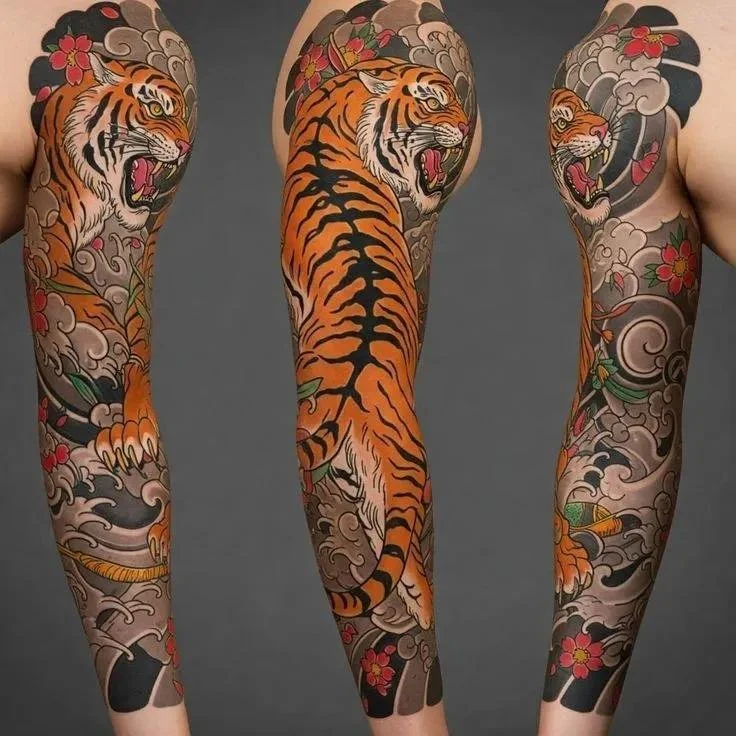
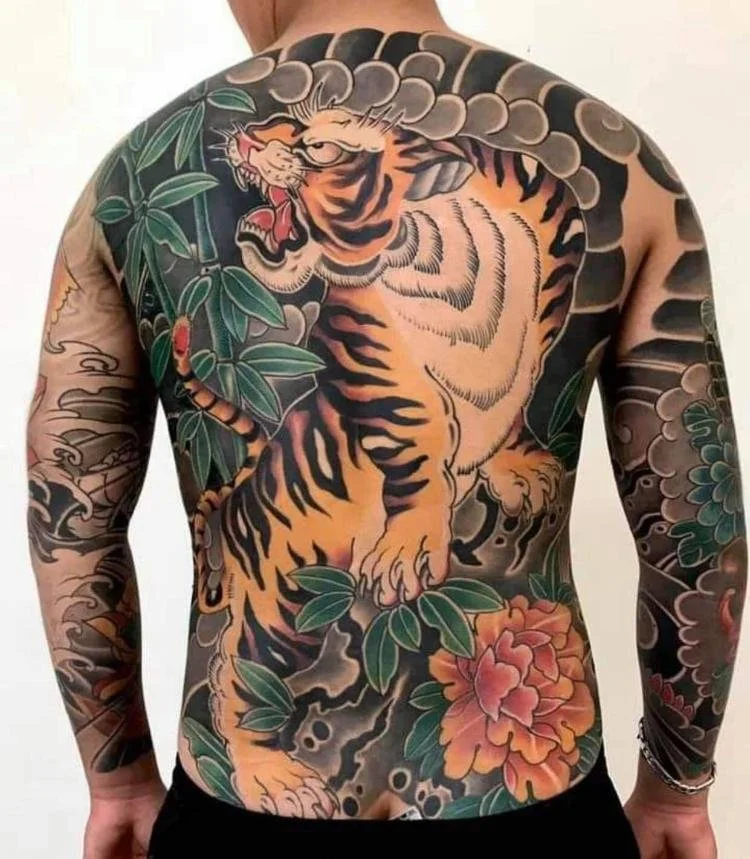
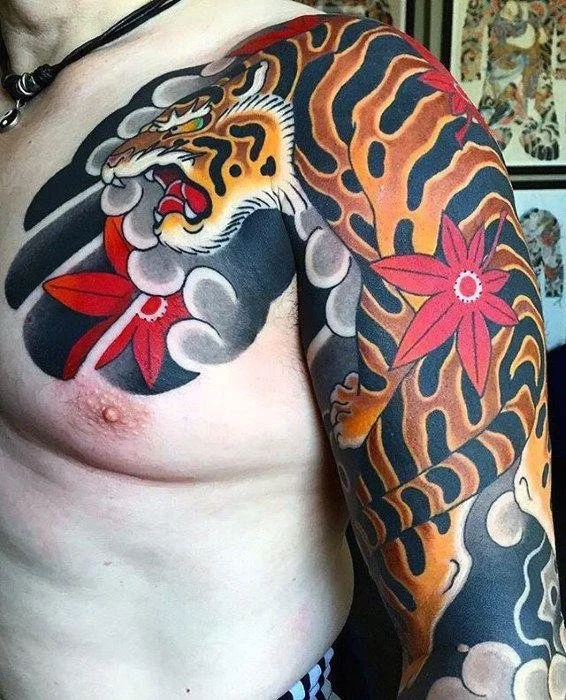
A tiger emerging through bamboo. Its body curves around the arm while leaves bend in the wind. Claws extend forward, teeth appear beneath a fierce expression, and dark Japanese-style backgrounds make the orange body stand out.
Cái Japanese Tiger Tattoo is immediately powerful. But its meaning goes deeper than aggression.
Across East Asian visual culture, the tiger has long carried associations with power and auspicious protection. In Japanese art, it became an especially compelling symbol of courage, strength and protective power—despite an interesting fact:
Tigers are not native to Japan.
So how did an animal that didn’t naturally live in Japan become such an important subject in Japanese art and, eventually, Irezumi? Its story begins long before the tattoo needle touches the skin.
What Does a Japanese Tiger Tattoo Mean?
A Japanese Tiger Tattoo most commonly represents a combination of:
• Lòng can đảm — facing danger rather than retreating from it
• Sức mạnh — physical and inner power
• Sự bảo vệ — the tiger as a powerful guardian figure
• Confidence — commanding presence and authority
• Khả năng phục hồi — remaining strong through difficult circumstances
However, there is no universal dictionary assigning one fixed meaning to every Japanese tiger. The meaning changes depending on its pose, surrounding elements and the story of the person wearing it.
A roaring tiger descending through bamboo creates a very different feeling from a calm tiger resting beneath the same plants. Traditional Japanese tattooing makes those relationships important.
The tiger is the subject. The composition tells its story.
Why Is the Japanese Tiger Tattoo a Symbol of Courage?
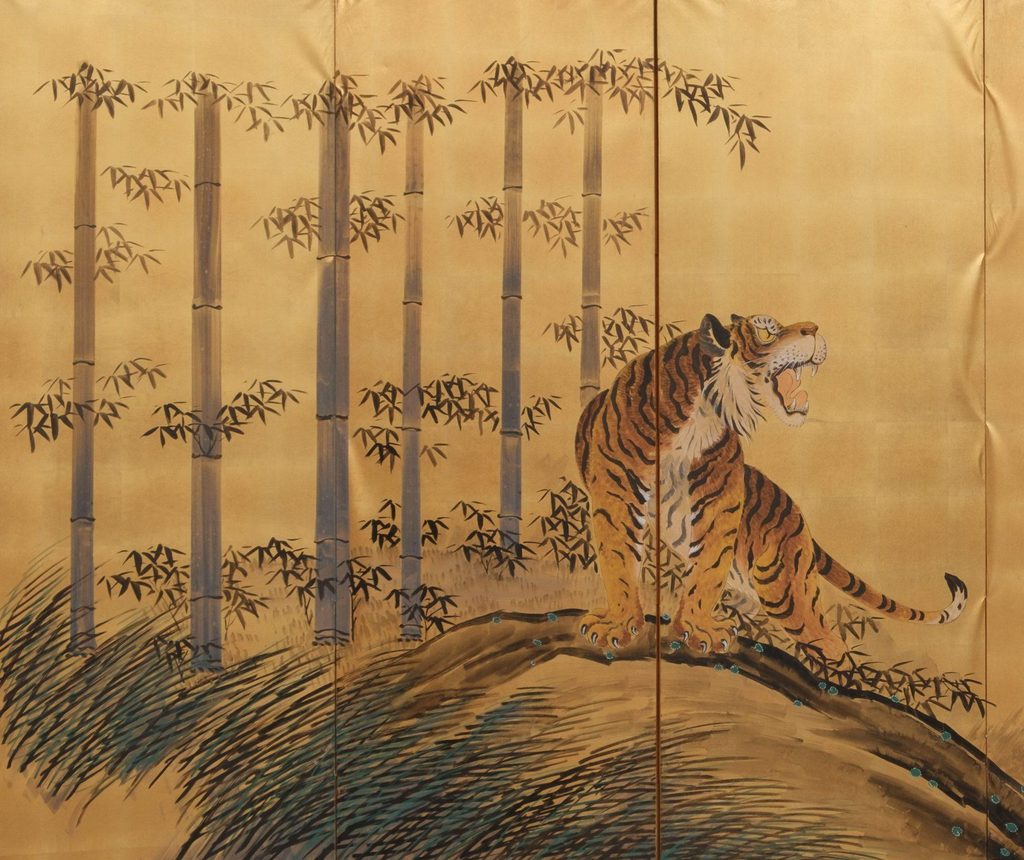
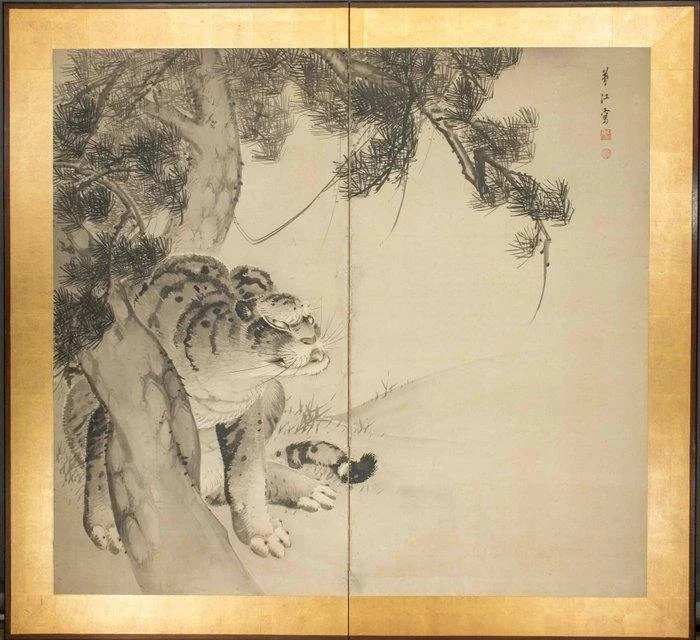
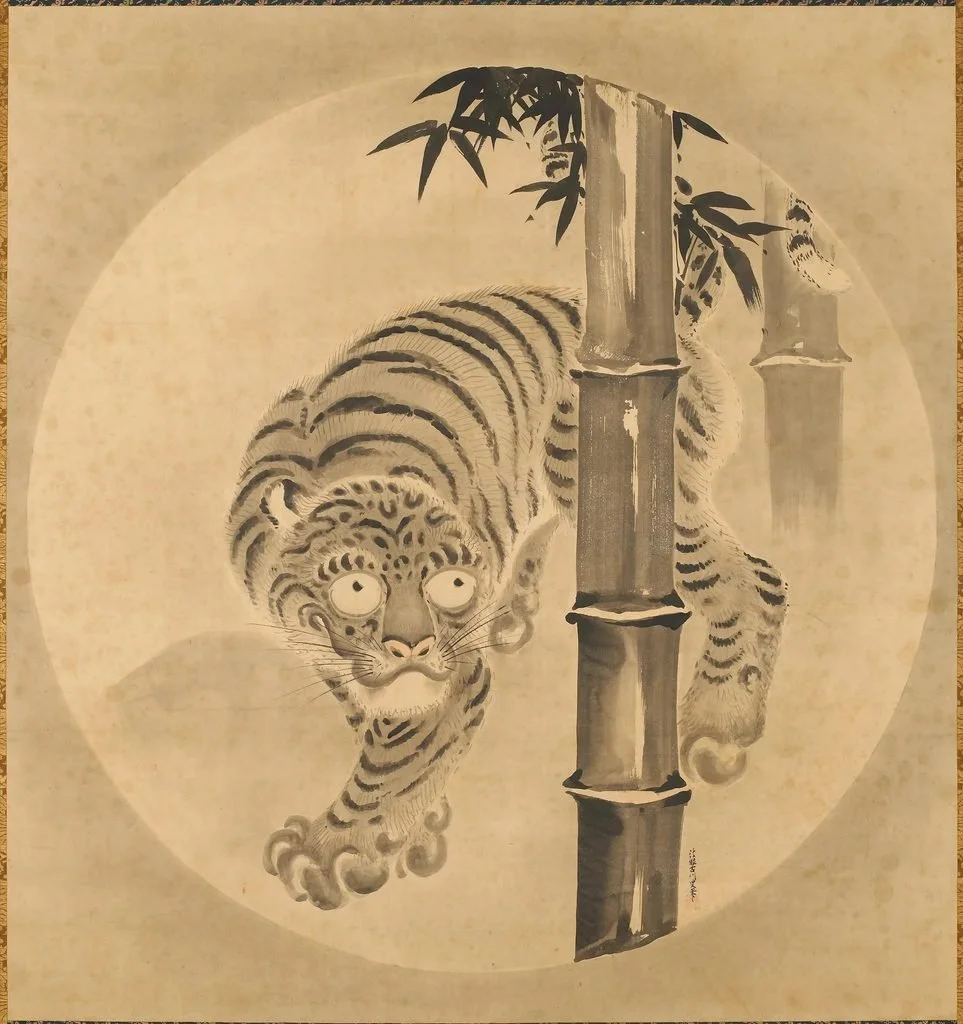
Few animals visually communicate physical power as immediately as the tiger.
Japanese artists inherited tiger imagery through centuries of cultural exchange with China and Korea. Because Japanese artists historically had little or no direct experience with living tigers, they often worked from imported images and established artistic models.
The result wasn’t necessarily naturalistic. It was symbolic.
The Metropolitan Museum of Art notes that Japanese artists depicted tigers from imagination as brave and fierce spirits, making tiger imagery particularly desirable among high-ranking warriors, including shoguns.
By the Momoyama period, dragon-and-tiger imagery had also become closely associated with warrior-class aesthetics. Met scholarship describes the tiger as retaining an underlying sense of mysterious protective power while coming to express the dignity of those who lived for battle.
That history helps explain why courage remains such a natural interpretation of the Japanese tiger today. A Japanese Tiger Tattoo can therefore represent someone who doesn’t want to live without fear. It can represent someone determined to move through fear anyway.
Đọc thêm: The Metropolitan Museum of Art
Why Does a Japanese Tiger Tattoo Represent Strength?
Strength is perhaps the most immediately recognizable meaning of a tiger tattoo. The animal’s muscular body, claws, teeth and controlled movement naturally communicate physical power.
But traditional Japanese imagery allows the meaning to extend beyond physical strength. An early eighteenth-century Japanese tiger painting in The Met describes the tiger as a longstanding auspicious symbol of power throughout Asia, appearing in both popular and elite culture.
For a tattoo wearer, that strength can become personal. It might represent:
• Surviving a difficult period
• Protecting family
• Emotional resilience
• Self-confidence
• Overcoming fear
• Refusing to surrender under pressure
This is why the tiger works particularly well for people who want a powerful tattoo without reducing its message to aggression.
Strength doesn’t always mean attacking. Sometimes it means refusing to fall.
Why Does a Japanese Tiger Tattoo Symbolize Protection?
The tiger’s protective symbolism has deep roots in East Asian visual culture. Historical Japanese art did not treat the tiger simply as a dangerous predator. It could function as an auspicious and guardian-like presence.
The Met describes the tiger as a mythological guardian animal and an auspicious symbol of power. Historical Tiger and Bamboo imagery could also carry ideas of strong leadership and social harmony. That protective dimension makes the tiger especially interesting in tattoo art.
A Japanese Tiger Tattoo may therefore symbolize:
“I have the strength to protect what matters to me.”
That might mean family. A partner. Personal values. Or even the wearer’s own boundaries.
This is one reason the tiger can feel simultaneously aggressive and protective. Its power does not necessarily exist to attack.
It can exist to guard.
What Does a Japanese Tiger and Dragon Tattoo Mean?

Few pairings are more iconic in East Asian art than the tiger and dragon. The pairing existed centuries before modern tattooing.
The Met describes the dragon and tiger as complementary creatures associated with the yin-yang principle in East Asian visual culture. The tiger could represent yin, while the dragon represented yang.
Another traditional distinction places:
Dragon → heavens
Tiger → earth
Together, they can suggest the relationship between opposing forces. Earth and sky. Wind and water. Physical and spiritual power. Yin and yang.
Rather than interpreting a tiger-and-dragon tattoo simply as “two powerful animals fighting,” it can be understood as a composition built around balance between different kinds of power.
What Colors Work Best for a Japanese Tiger Tattoo?
Traditional Japanese tiger imagery gives artists several possibilities.
Orange Japanese Tiger Tattoo
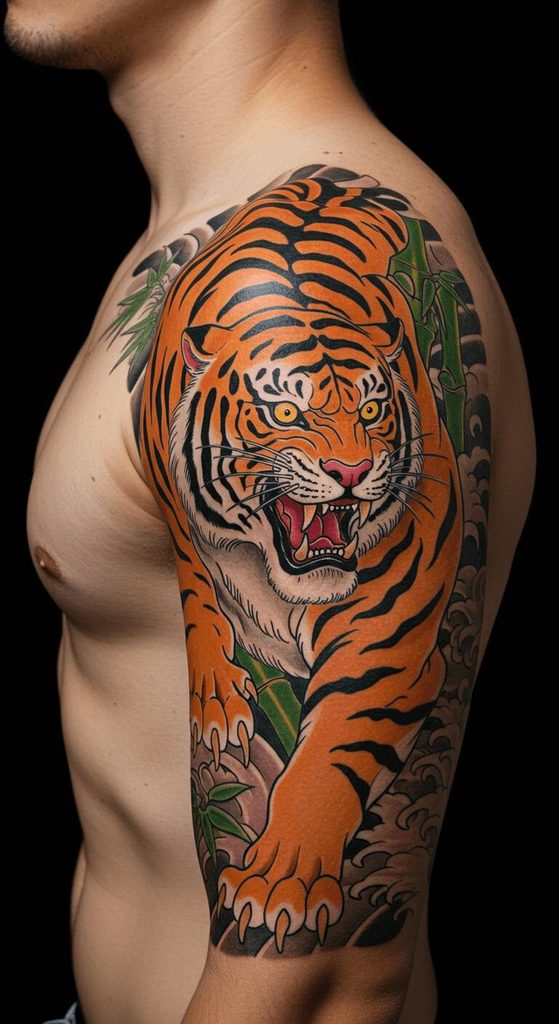
Orange, black and warm yellow tones create the most immediately recognizable tiger appearance. The contrast also allows the tiger to stand strongly against dark clouds, wind bars and green bamboo.
Black and Grey Japanese Tiger Tattoo
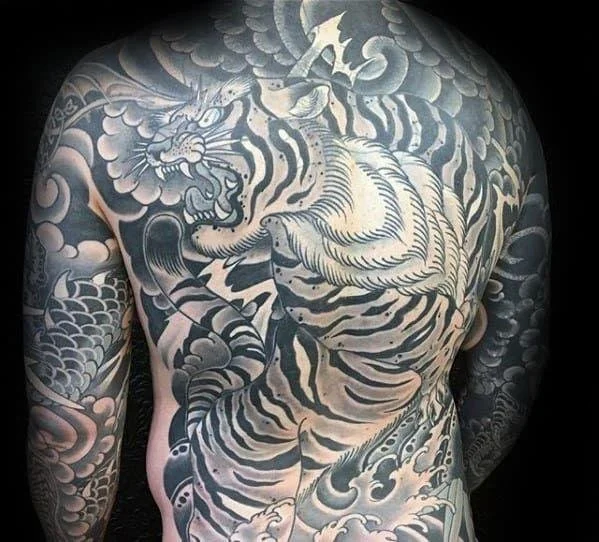
Black and grey can make the design feel heavier and more dramatic while emphasizing texture and movement.
White Tiger Tattoo
White tiger imagery has its own broader East Asian symbolic history, so it shouldn’t simply be treated as an ordinary tiger with the colors changed.
If you’re interested specifically in the White Tiger or Byakko, that subject deserves its own cultural research before developing the tattoo.
Where Does a Japanese Tiger Tattoo Work Best?
Tiger anatomy makes the subject extremely adaptable. The curved spine, long tail and powerful limbs allow an artist to create movement across different parts of the body.
Japanese Tiger Sleeve Tattoo
The arm works particularly well because the tiger can descend or climb while bamboo, wind and flowers wrap around it.
Japanese Tiger Back Tattoo
The back provides enough room to make the tiger the dominant subject. This is especially effective for scenes involving bamboo, rocks, wind or another major creature.
Japanese Tiger Thigh Tattoo
The thigh offers a broad surface for the tiger’s torso and allows the composition to extend into a larger leg piece later.
Japanese Tiger Chest Tattoo
The chest can work particularly well when the tiger belongs to a larger sleeve or torso composition. For large Japanese tattoos, placement shouldn’t be decided independently from future plans.
If you eventually want a bodysuit, sleeve or backpiece, tell your artist before the first piece is designed.
Is a Japanese Tiger Tattoo a Yakuza Tattoo?
Not automatically.
Traditional Japanese tattoos became strongly associated with the Yakuza during modern Japanese history, but the artistic tradition itself is much broader.
A tiger does not identify someone as a Yakuza member. Nor is there a universal rule saying a tiger represents a particular criminal rank.
Japanese tiger imagery existed in art long before the modern Yakuza stereotype, including paintings associated with warrior culture, Buddhist contexts and broader East Asian symbolism. The Metropolitan Museum of Art
Understanding this distinction prevents traditional Japanese imagery from being reduced to gangster symbolism.
Đọc thêm: Yakuza Tattoo History: How Tattoos Became Linked to the Yakuza
Frequently Asked Questions About Japanese Tiger Tattoo
1. What does a Japanese Tiger Tattoo mean?
A Japanese Tiger Tattoo commonly represents courage, strength, protection and resilience. Its specific meaning can change depending on the tiger’s pose and accompanying elements.
2. What does a tiger and bamboo tattoo mean?
Tiger and bamboo can combine strength with resilience. Bamboo’s ability to bend without easily breaking also makes it a powerful visual partner for the tiger.
3. Why are tigers important in Japanese art if there are no tigers in Japan?
Tigers are not indigenous to Japan. Japanese artists encountered tiger imagery through cultural exchange with China and Korea and developed their own imaginative interpretations of the animal. The Metropolitan Museum of Art
4. What does a Japanese tiger and dragon tattoo mean?
The tiger and dragon are traditionally complementary creatures in East Asian art. They can represent yin and yang, earth and heaven, and wind and water. The Metropolitan Museum of Art
5. What flowers go with a Japanese Tiger Tattoo?
Peonies are a popular visual pairing, while other flowers may be appropriate depending on the composition, symbolism and seasonal relationships within the design.
6. Is a Japanese Tiger Tattoo associated with the Yakuza?
Traditional Japanese tattooing has historical associations with the Yakuza, but a tiger tattoo does not indicate Yakuza membership. Tiger imagery has a much broader history in Japanese and East Asian art.
7. Where should I place a Japanese Tiger Tattoo?
Sleeves, backs, thighs and larger leg compositions work particularly well because they provide enough room for the tiger’s anatomy and surrounding background to remain readable.
Final Thoughts: What Does a Japanese Tiger Tattoo Represent?
A Japanese Tiger Tattoo is ultimately about power—but not power without purpose. It can represent the courage to face difficulty, the strength to survive it and the power to protect what matters.
Its meaning becomes even richer when combined with bamboo, wind, flowers or the dragon. That is what makes the tiger such an enduring subject in Japanese tattoo art:
It doesn’t simply look powerful. It tells a story about how power is used.
Create Your Japanese Tiger Tattoo in Hanoi
Thinking about a tiger sleeve, backpiece or custom Japanese composition?
Tại Hình xăm lá bài 3 bích Hà Nội, our artists can help develop your Japanese Tiger Tattoo around your story, placement and body—not simply copy an existing design.
Send us your reference images, preferred placement, approximate size and Hanoi travel dates before your visit.
Every tattoo has a story. Let’s create yours.